

Thirty years ago I was trimming out a house with a set of hardware store chisels and a wooden mallet, telling myself they were good enough. I am 61 now, retired four years from finish carpentry after 34 years, and I build furniture in a two-car garage shop outside Boise, Idaho. The lie I told myself for most of that career was that a chisel is a chisel. It is not. The difference shows up in the first paring cut on a hinge mortise, and it keeps showing up every time you pick the tool up.
When I retired, I rebuilt my hand tool kit in the first winter. The Narex six-piece set was part of that order, along with a combination square and a Norton oil stone. That was three years ago. I bought the set because I did not want to keep reaching for job-site tools at home, and because I wanted to find out whether a matched set of bench chisels would make me work differently. It did.
The set runs 6, 10, 12, 16, 20 and 26 mm. The blades are chrome-manganese steel, hardened to Rc 59, and ground at a 25 degree bevel. The handles are European beech and the set comes in a wooden presentation box. Those are the facts. What matters is how the tool sits in your hand when you are paring a dovetail or cleaning up a mortise. The bevel edges let me get into a corner without the tool fighting the work.
They do not arrive sharp enough to use. I spent about an hour flattening the backs and honing the edges before the first cut. That hour is not optional. If you take a new chisel to wood straight out of the box and it skates, you will blame the tool. Blame the edge. Once the backs were flat and the bevels were honed, the chisels cut the way a chisel should cut. They bit, they tracked, and they left a surface I could read.
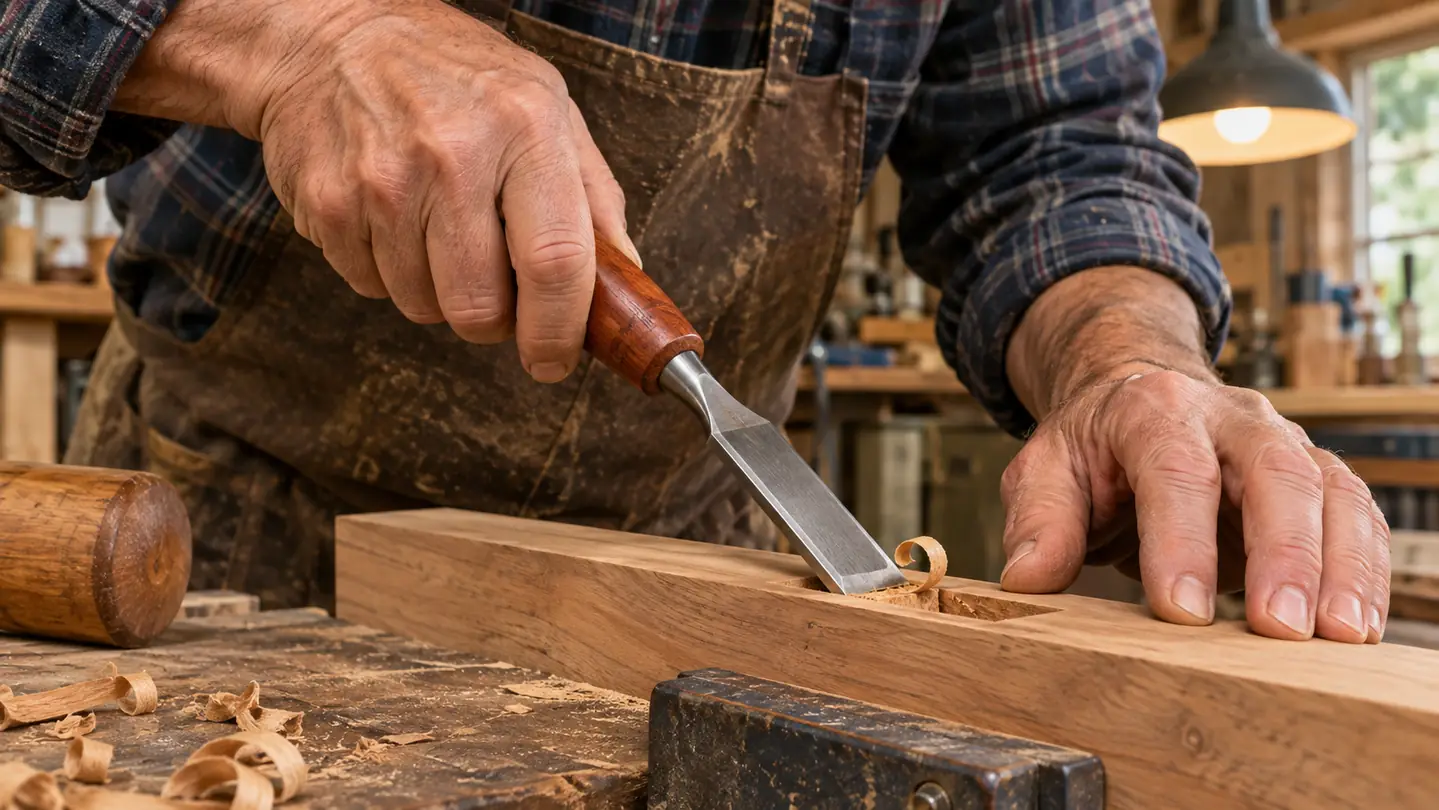
The first project after I set them up was a batch of cutting boards for Christmas gifts. That is not fine furniture, but it taught me what I needed to know. The chisels cleaned up the glue lines and pared the end grain without tearing it. I used a wooden mallet, never a steel hammer. The handles have no steel hoops or strike caps, so a steel hammer is the wrong tool. That is not a flaw. It is a rule.
I spent one hour flattening the backs and honing the edges. That hour changed how the next three years of work felt.
The set I stopped fighting with
Six bevel-edge sizes from 6 to 26 mm, chrome-manganese steel at Rc 59, European beech handles, wooden box. Plan on an hour of flattening and honing before the first cut.
Amazon See the Narex 6-Piece Set on Amazon →What I notice most is control. A dull chisel makes you push. A sharp one lets you steer. When I am paring a hinge mortise or cleaning the waste out of a dovetail, I want the tool to go where I put it and stop where I stop. The Narex chisels do that. The edge holds long enough that I am not stopping every few minutes to touch it up, and the back is flat enough that I can register it against the work without rocking.
The sizes I reach for most are the 12 mm and the 16 mm. The 6 mm and 10 mm handle finer work, cleaning out corners and paring small joints. The 20 mm and 26 mm move waste faster when I am chopping a mortise or trimming a tenon. I like that the set covers the range without a lot of gaps. I do not have to make one chisel do a job it was not sized for.
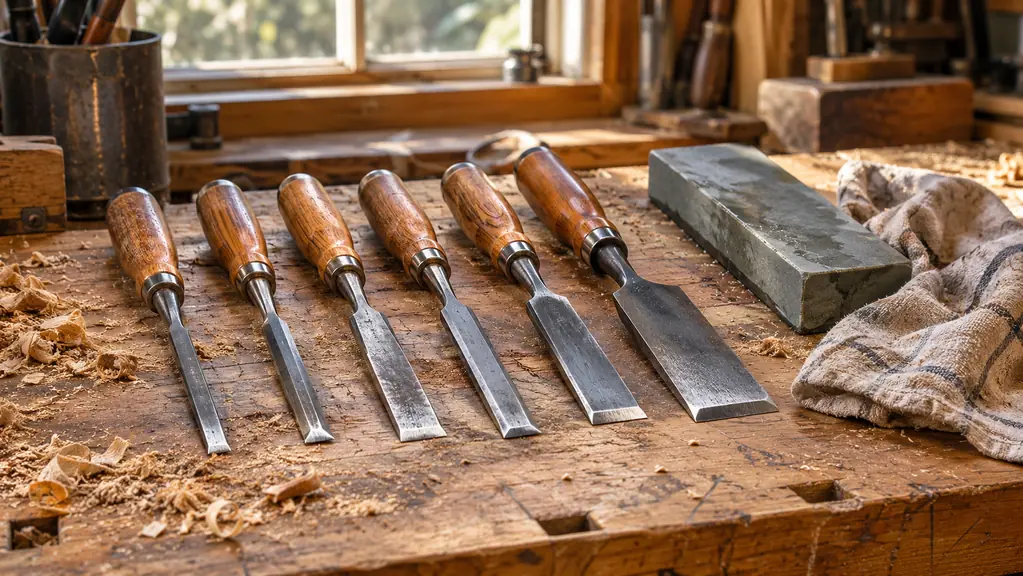
I still keep my old hardware store chisels in a drawer. I use them for rough work, scraping glue or opening a paint can, the jobs I would not ask a good edge to do. That is the honest comparison. The old chisels needed constant attention and still felt soft on the stone. The Narex chisels hold an edge and they sit flat on the work. I would not go back to the old set for furniture.
Sharpening is part of the deal. I use the Norton oil stone with a light honing oil, a simple side-clamp guide, and a leather strop. I hone at 30 degrees on the 25 degree bevel. I check the stone for flatness once in a while. None of this is difficult, but it is a habit. If you are not willing to sharpen, a good chisel will not stay good for long.
If you are newer to hand tools, the part that surprises you is how much the flat back matters. You cannot hone a good edge on a back that is not flat. That was the hour of work on the first day, and it is the reason the chisels have performed ever since. The wooden box is nice, but the box is not the point. The point is the steel and the edge.
What I'd Tell You If We Were Sitting at My Kitchen Table
If we were sitting at my kitchen table, I would tell you not to buy a set because it looks good in a box. Buy it because you are going to sharpen it, use it, and keep it for a long time. The Narex set is what I would buy again. It has the sizes I use, the steel takes a good edge, and the bevel edges let me work into corners without fighting the tool. Plan on the hour of setup. Sharpening is not a sign that the tool is bad. It is part of owning a chisel.
I would also tell you to keep your old chisels. Do not throw them away. A rough chisel has a place in the shop, and it keeps you from reaching for a good edge when you are doing something careless. The Narex chisels are for the work that matters. The old ones are for the rest. That is how I have run my bench for three years, and I do not expect to change it.
A chisel should not be the reason you stop
The Narex six-piece set covers the sizes I use for paring and chopping joints, and it comes in a wooden box that keeps the edges from knocking around. If your bench still has the chisels you settled for, this is the upgrade I would make.
Amazon View the Narex Set on Amazon →