

I spent 34 years hanging trim and setting cabinets, and for most of that time the chisel in my apron came off the same aisle as the light bulbs. It worked. A hardware store chisel will cut a hinge mortise, clean out a dado and take a rap from a steel hammer without coming apart. So this is not a piece about how the cheap ones are junk. It is about what changed in my shop three years ago, when I stopped using them for the work that mattered and started keeping them for the work that did not.
Short answer: the Narex chisels hold a honed edge longer, and they arrive flat enough that one hour at the stone gets all six working. Hardware store chisels win on rough work, on lending one to a helper, and on the plain fact that a lot of us already own a handful of them. Buy the Narex set for joinery. Keep the old ones in a coffee can for prying, scraping and anything that might have a nail buried in it.
| Narex 6 piece set | Hardware store chisels | |
|---|---|---|
| Edge holding | Holds a honed edge through a full evening of paring cherry | Wants a touch up partway through the same job |
| Steel | Chrome-manganese steel, hardened to Rc 59 and tempered evenly across the set | Alloy is usually not stated anywhere, and hardness varies from one chisel to the next |
| Sizes | 6, 10, 12, 16, 20 and 26 mm, one matched progression | Whatever the bin had that day, rarely a useful spread of widths |
| Out of the box | Backs need flattening and edges need honing, about an hour for the whole set | Rarely flat, and the bevel angle is whatever the factory felt like grinding |
| Handles | Stained European beech, comfortable in the hand, no steel hoop and no strike cap | Plastic or rubber over a steel shank, takes a hammer blow without splitting |
| Rough work | Too fine to run into a painted frame that might be hiding a nail | Made for prying, scraping glue and being loaned out |
| Cost | More up front, for six chisels in one box | Cheap enough to own several, and most shops already have them |
| Storage | Wooden presentation box keeps the set together and the edges off each other | Rolled in a rag or loose in a drawer |
| Best for | Paring and chopping joinery on furniture | Demolition, cleanup and the job site |
Where Narex Wins
The first difference shows up at the oil stone, not at the wood. The blades in this set are chrome-manganese steel, hardened to Rc 59, tempered evenly from the 6 mm up to the 26 mm. That evenness is the part nobody talks about. When I flatten the back of a chisel I want to know what I am working with before I start, and I want the next chisel in the set to behave the same way. With the old bin chisels, two of the same width could come off the stone at different angles and cut like two different tools. Three years in, all six of mine still feel like they came out of one shop.
The second difference is the sizes. You get 6, 10, 12, 16, 20 and 26 mm, which is a working progression rather than a random handful. The 6 mm cleans out a narrow mortise. The 12 mm is the one I reach for most, paring shoulders on end table aprons and cleaning up half blind dovetails. The 26 mm takes a wide shaving off a tenon cheek in one pass, which is exactly where a dull chisel makes you do the work twice. These are bevel edge chisels, so the sides taper and you can get into a corner without the corner of the blade bruising the wall of the joint. One evening on the shaker end tables I had four aprons to fit and the 16 mm did all of it, shoulders and cheeks, and I never opened the box for a second chisel. With the old bin set I would have been swapping between two widths that were close but not close enough, and shimming the joint to cover it.
Where Hardware Store Chisels Win
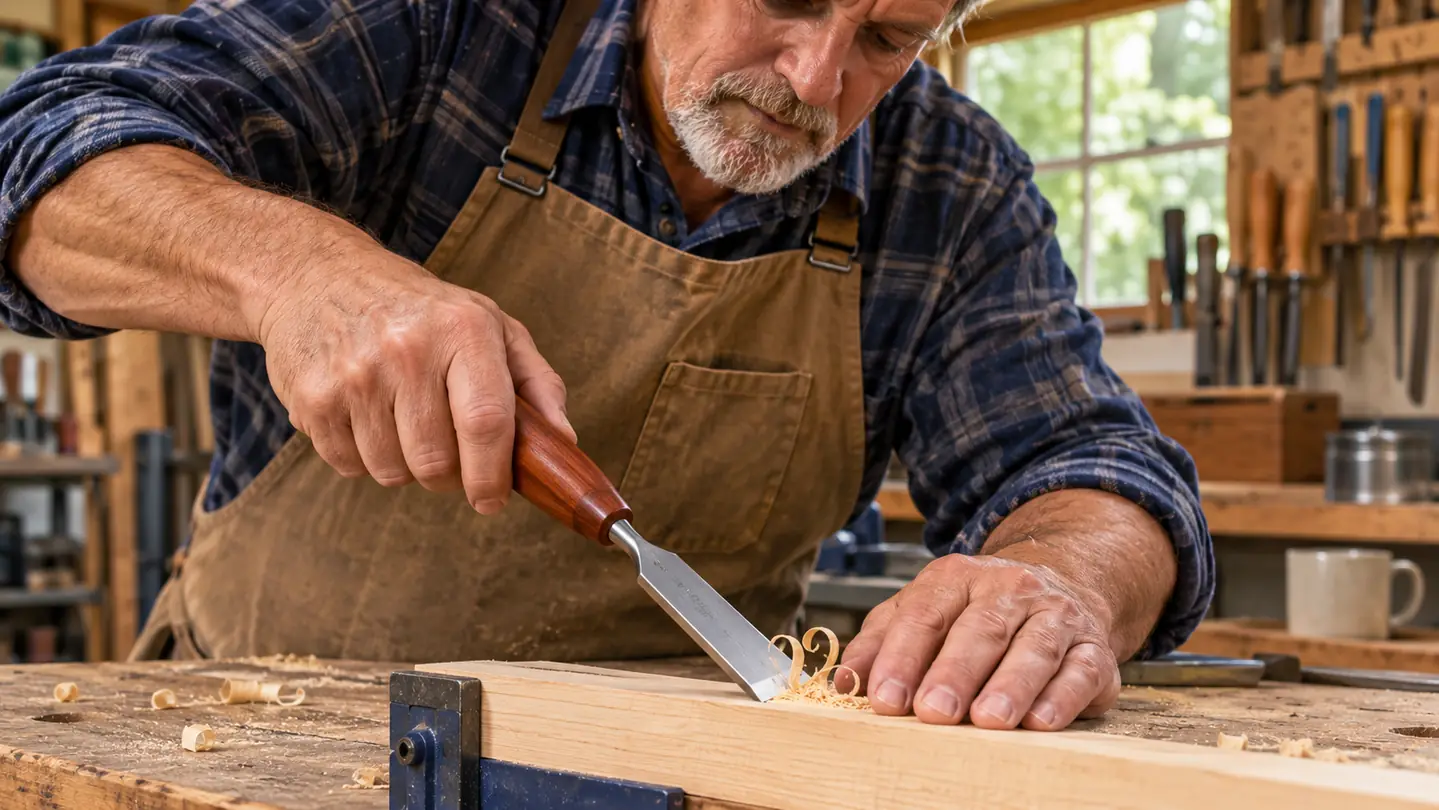
Start with the handles, because this is where the Narex set gives something up. The handles are stained European beech, comfortable and warm in the hand, and there is no steel hoop and no strike cap on the end. That is a real limitation and I will not dress it up. I strike mine with a wooden mallet, always, and I have since the day I bought them. The chisels from the hardware store usually wear a plastic or rubber handle over a steel shank, and that handle will take a hammer blow all afternoon without complaining. Back when I was hanging doors for a living, I cut three hinge mortises in a prehung oak slab with one hardware store chisel and a steel hammer and never thought twice about it. That is the whole case for the plastic handle, right there. It did not need to be sharp. It needed to be there.
Then there is rough work. A chisel that costs real money is a chisel you think about before you use it. I have pried a painted casing loose with a hardware store chisel, scraped dried glue off a joist, and opened a can of finish with the same one. I would not do any of that with the Narex. The old set lives in a coffee can under the bench and it earns its keep every month, just never on joinery. If what you need is a tool for demolition, cleanup and loaning to a neighbor, the bin chisel is not a compromise. It is the correct tool for that job.
Six sizes, one box, and one evening at the stone
I bought this set the winter after I retired and it has been the only bench chisel I use since. If the edge in your hand is giving up halfway through a joint, the fix is usually the steel, not your technique. Check today's price on Amazon and read the sizes against the work you actually do.
Amazon Check Today's Price on Amazon →The Hour Before the First Cut
The Narex chisels do not arrive sharp. I want that said plainly, because a beginner opening that wooden presentation box will put one to a piece of pine and come away disappointed. The backs are not flat enough to trust and the bevels need honing. The listing says the blades are ground at a 25 degree bevel, and on mine they were, roughly, but ground is not honed. Plan on an hour for the set, spread over one evening, and do not skip it.
I flatten a back on the coarse side of the Norton oil stone, work up through the fine side, then hone the bevel with a simple side clamp guide set so the edge sits at 30 degrees on that 25 degree grind. The steeper micro bevel means less steel to remove each time and an edge that still registers flat against the work. I finish on a leather strop. Six chisels, one evening, and then they are yours and they stay yours. The 26 mm took the longest, because a wide back is more surface to bring flat and you can feel every bit of it. I checked each back against the side of my combination square, held up to the window light, before I moved to the bevel. It is a slow job and a dull one, but it is the only hour in this whole business I have never regretted spending.
Compare that with the hardware store chisel, which you might get an hour out of and might not. The steel in those is rarely stated on the tool or the packaging, and it varies. Sometimes you get one that hones up beautifully and surprises you. Sometimes you get one that will not hold what you gave it no matter how long you spend at the stone. That uncertainty is the real cost of the cheap set. Not the money. Not knowing whether the tool or your sharpening is at fault.
Three years, six chisels, one oil stone, and the 12 mm still pares end grain on cherry clean enough to leave alone.

Three Years on the Same Six Chisels
I bought these the winter after I retired, along with a combination square and a set of small clamps, because I did not want to keep using beat up job site tools in my own shop. That was three years ago. Since then they have cut the joinery on a cherry bookcase two winters back, the walnut dining table I built for Marit last winter, and the shaker style end tables I am finishing this year. Cutting boards every Christmas, though those are mostly band saw and planer work.
What has changed is the handles. Beech darkens with hand oil and the ends take a little mushrooming from the mallet. What has not changed is how long an edge lasts. Paring cherry is easy on a chisel and walnut is not much harder. The test I actually watch is end grain, because a chisel that is even slightly dull will skate and crush instead of slice. The 12 mm still slices. Last winter on the walnut table I chopped eight mortises in the legs with the 12 mm and the 10 mm, and I touched the 12 mm up once, at the start, not in the middle. With the old chisel of the same width I would have been back at the stone twice. That is the difference that adds up over a project. I hone it, strop it, and put it back in the box.
The wooden presentation box turns out to matter more than I expected. Six chisels rolling around in a drawer knock their edges against each other, and you spend the first ten minutes of every session repairing what the drawer did. The box holds each one in its own slot. I am not sentimental about packaging, but a box that keeps edges apart is a sharpening tool as much as a storage one.
If You Are Standing in the Aisle Deciding
If you are going to buy the cheap chisel anyway, and there are good reasons to, check three things before you pay. Lay the back against the edge of the shelf and see whether it rocks. Look down the bevel and see whether the grind runs even from side to side. Then grip the handle, because a chisel that does not sit right in your hand will wear on you by the end of an afternoon.
None of that will tell you how the steel holds up. Only the stone tells you that, and it takes a few sharpenings before the answer shows. That is the argument for buying one chisel instead of a set from the bin. Pick the width you use most, live with it for a month, and let the tool tell you what it is.
The other argument for the Narex set is that the question is settled. Six matched chisels, one grade of steel, one bevel angle across the set. You flatten, you hone, you work. I spent enough years guessing at the bin that I stopped enjoying the guessing somewhere around the twentieth year.
Who Should Buy Which
If you are cutting dovetails, chopping mortises or paring tenon cheeks on furniture in a home shop, buy the Narex set. You will spend an hour getting it ready and then you will stop thinking about your chisels, which is the highest compliment a hand tool can get. It suits someone willing to learn the stone, because good steel and a careless sharpening habit still give you a bad edge. The set carries you from a 6 mm mortise cleanup to a 26 mm tenon cheek without hunting for a missing width.
If you are hanging a door once a year, prying trim, scraping glue or working somewhere tools walk away, buy the hardware store chisel and keep buying it. There is no shame in that and I did it for 34 years. The honest question is not which chisel is better in the abstract. It is which chisel fits the work in front of you, and for rough work the answer is the cheap one in the coffee can.
Most home woodworkers I talk to end up with both, and that is where I landed. The matched set stays in the box and comes out for joinery. The old ones stay under the bench and come out for everything else. If you have a decent set already and it is holding an edge, you do not need to replace it. Sharpen what you have and put the money into lumber.
The set I would buy again with my own money
Six chisels, 6 through 26 mm, chrome-manganese steel at Rc 59, in a box that keeps them apart and keeps their edges honest. Three years in my shop and I have not wanted a different bench chisel. Check today's price on Amazon and see whether the sizes line up with the joints you build.
Amazon Check Today's Price on Amazon →