

Three winters ago I rebuilt my hand tool kit. I had spent 34 years as a finish carpenter, and the chisels I brought home from job sites were the ones I had beaten on for a living. Nicked edges, handles mushroomed from being tapped with whatever was within reach, backs that had never been flat since the day I bought them. I wanted one set at the bench that stayed true and stayed sharp. I bought the Narex six-piece set that first winter after I retired, and it has not left the shop since.
This is not a review written after a weekend. It is three years of paring and chopping in a two-car garage outside Boise, on a maple bench I built myself, in a shop with a concrete floor and one small electric heater that does not really keep up in January. The chisels have been through a cherry bookcase, a walnut dining table for my wife Marit, a pair of shaker end tables and a stack of cutting boards every Christmas. What follows is what I noticed, in the order I noticed it.
The Quick Verdict
Three years of hard use and the edges still come back on an oil stone in a few passes. Plan on an evening of flattening before the first cut, because they do not arrive sharp.
Amazon Check Today's Price →Six chisels, one box, and one evening before the first cut
That evening is the only real catch. Once the backs are flat, the Narex set does everything a bench chisel gets asked to do in a home shop, and it keeps doing it after three winters.
Amazon Check Today's Price on Amazon →How I've Used It
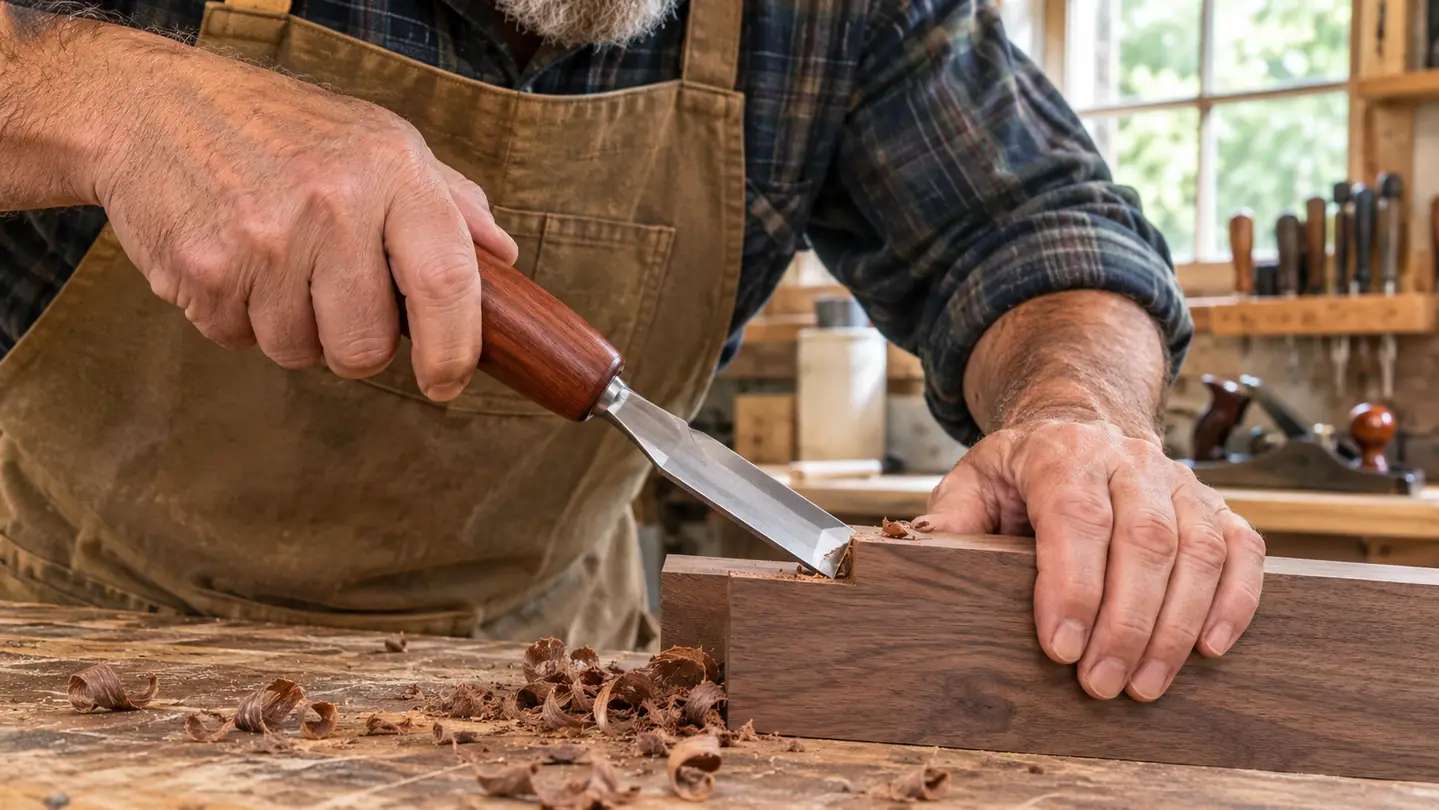
Every joint in my furniture gets pared or chopped by hand at some point. Machines get me close and a chisel takes the last of it. The Narex set has done all of that work for three years. Chopping mortises in the shaker end tables, cleaning waste out of half-blind dovetails on the cherry bookcase, paring tenon shoulders flush on the walnut table, and trimming cutting board ends so the glue lines meet clean. Not one joint in three years was finished by machine alone.
The shaker end tables this year are the clearest example of what that looks like. Two tables, four legs apiece, two mortises in each leg for the aprons. That is sixteen mortises per table and thirty-two across the pair. I laid them out with the IRWIN combination square, bored most of the waste out at the drill press, and then chopped the rest square with the 12 mm and cleaned the walls with the 16 mm. Every one of those thirty-two mortises was chopped with a wooden mallet and the same two chisels. The chisel that started that run finished it. No edge rolled, no corner chipped, and the aprons went in with a light tap and stayed.
The rule at my bench is simple. These chisels get struck with a wooden mallet and nothing else. No steel hammer, no tapping with the butt of a saw handle, no driving them with the heel of my hand when I am impatient. There are no steel hoops and no strike caps on these handles, so a steel hammer would chew the beech apart inside a season. A wooden mallet has left them looking used and nothing worse.
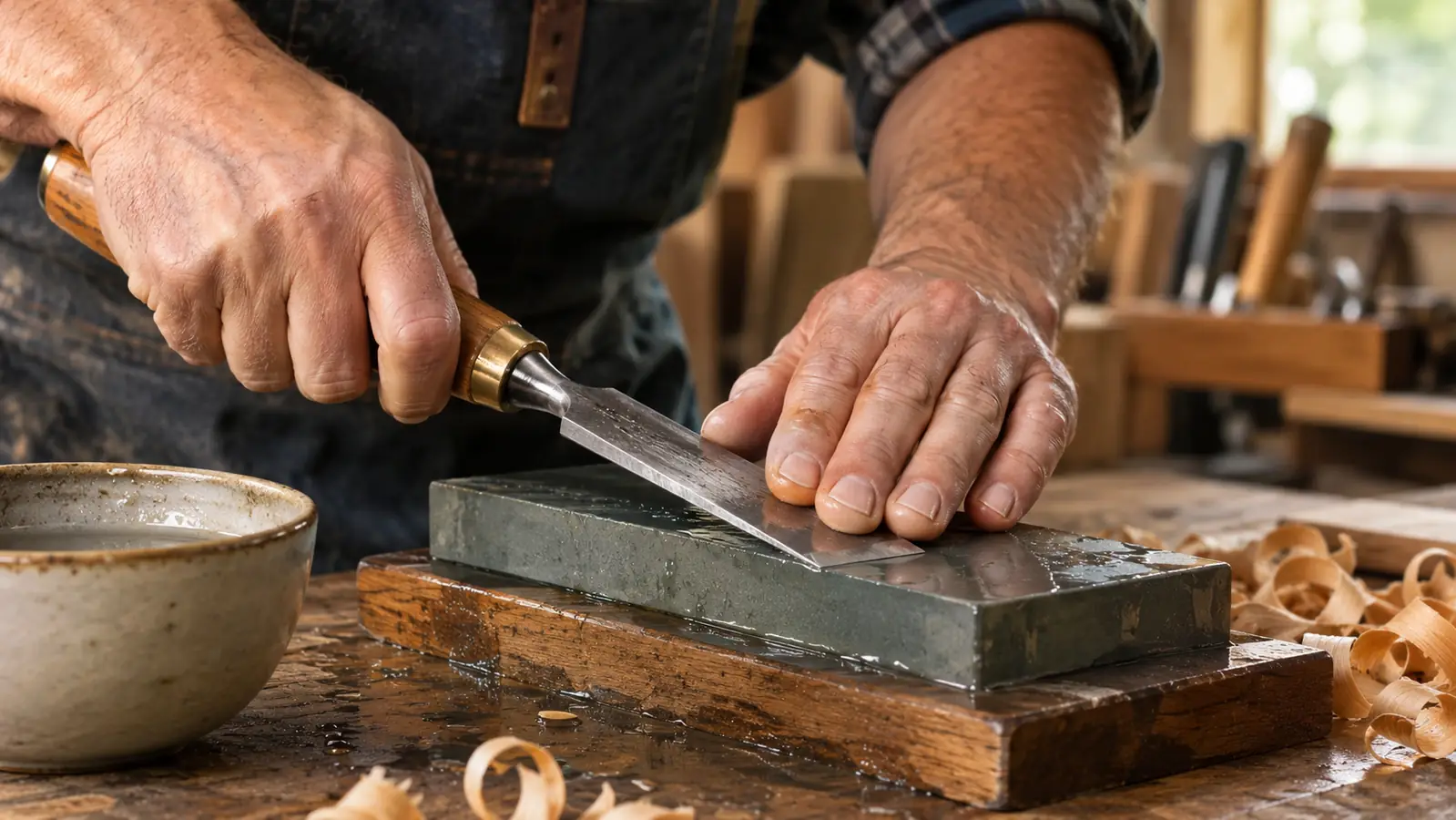
Sharpening happens on the Norton oil stone. The coarse 100 grit side comes out when an edge needs repair, the fine side for honing. Light honing oil, never water. I use a simple side-clamp honing guide, hone at 30 degrees on the 25 degree bevel the chisels come ground at, and finish on a leather strop. Every chisel in the set goes through the same routine. From a dull edge back to the bench is about five minutes if nothing is nicked, and I check the stone for flatness once in a while because a hollow stone will not give you a flat back.
What Came in the Box, and the Hour It Cost Me
The set is six bevel-edge bench chisels in metric sizes: 6, 10, 12, 16, 20 and 26 mm. Chrome-manganese steel hardened to Rc 59, ground at a 25 degree bevel, stained European beech handles, and a wooden presentation box. The whole set weighs about a pound and a half. Nothing about the box is fancy and nothing about it is flimsy. It has sat on a shelf under my bench for three years and the lid still closes flat.
What surprises most people, and what surprised me, is that they do not arrive sharp. The backs are not flat and the bevels are ground but not honed. Take one out of the box and try to pare end grain and you will think you bought a bad set of chisels. You did not. You bought chisels that need setup.
Flattening the back of each chisel is the job, and it is the whole job. I spent about an hour on the set, working the backs flat and honing each bevel afterward. The 26 mm took the longest because there is simply more steel to bring down. After that hour the set was a different tool, and the first paring cut told me so. That hour is the honest cost of these chisels. It is time, not money, and it is not optional.
I started it the way I had done it for most of my career, with a sheet of wet-or-dry paper stuck down to a plate of glass. That works, and I am not going to pretend it does not. It is also slow, and on the 26 mm it was going to eat most of an afternoon before the back came flat. So I switched to the coarse 100 grit side of the Norton oil stone, which cuts faster on chrome-manganese steel than paper does, and worked each back in overlapping strokes until the scratches ran the full length of the blade instead of sitting in the middle. Then I checked each one against the straight edge of my bench and held it under the light. An even scratch pattern end to end is what flat looks like. That is what I looked for before I moved on to honing.
I would rather do that hour than buy a set that arrives sharp and then will not hold an edge past lunch. The setup tells you something about the steel before you ever put it to work. If a back comes flat in ten minutes and stays flat, the steel is sound.
How the Steel Has Held Up Over Three Years
Rc 59 is a middle hardness for a bench chisel. Hard enough to hold an edge through a run of paring, soft enough that it will not shatter the first time it meets a hidden staple in a board you thought was clean. I chipped one edge in three years, on the 12 mm, hitting a knot in a piece of cherry I should have looked at twice. The coarse side of the stone took the nick out in a few minutes and the chisel went back to work.
Two winters ago, on the cherry bookcase, I cleaned the waste out of sixteen half-blind dovetails in the carcase. Cherry is soft enough to pare cleanly and grainy enough to tear if an edge is anything less than sharp, so it tells you the truth about a chisel faster than oak will. I honed at the start of that run and did not go back to the stone until the last pin was cleaned. The 12 mm took the corners and the 6 mm did the small work at the tail ends. When I finished, the edges would still shave hair off my forearm. A dull chisel tears cherry and leaves a shadow line down in the socket that you cannot sand your way out of.
Compared with the hardware store chisels I used for decades, the difference is how long an edge lasts. Those old ones needed attention constantly, sometimes twice in a session. The Narex chisels hold through a full afternoon of paring and need nothing more than a strop or a few passes on the fine side of the stone. I still keep the old ones on a shelf for opening cans of finish and scraping glue, which is about all they are good for now.
I have not had a handle come loose, crack, or work its way off a tang. Three winters in an unheated garage is hard on wood, and the beech has moved a little with the dry cold, but nothing has failed.
The Handles, the Box, and the Mallet Rule
The handles are stained European beech, and they are comfortable in a way that is hard to explain without holding one. They are shaped so your hand finds the same spot every time you pick one up. After three years the finish has worn thin on the high spots of the 16 mm and the 20 mm, and the wood there is smooth as a river stone. That is not damage. That is what a working handle looks like after three years of honest use.
Winter is where a handle earns its keep or fails. My shop is unheated apart from that small electric heater, which runs while I am out there and quits the moment I come in. So the chisels go from near freezing up to whatever an hour of heat has managed and back down again, all winter long, and beech will move under that. Mine has. On the coldest mornings the handles have shrunk a touch and you can feel the tang seat a little differently in your palm. Nothing has cracked and nothing has loosened, and after three or four cuts the wood has settled back against my hand. In January, if I know I will be away from the bench for a week, I carry the box inside and set it on the shelf in the mudroom, then carry it back out when I am ready to work again.
No steel hoops, no strike caps. That is the tradeoff for handles this comfortable and this easy on the hand. If you mortise with a steel hammer, this is the wrong set for you and no amount of care will fix it. With a wooden mallet the tops of the handles collect dents and nothing worse. I have seen a chisel with a split handle in another man's shop. It happens when that rule gets ignored.
The wooden presentation box is a nice thing to own. Mine holds the set on a shelf under the bench. Some people will want a roll or a wall rack instead, and that is fine. The box is not a reason to buy these chisels and it is not a reason to avoid them.
Where They Fall Short
Two complaints and one caveat. The 26 mm is the chisel I reach for least, because work that wide is rare in the furniture I build. When I do need it, it is usually a single paring cut on a table apron shoulder, and it does that beautifully. The other five sizes carry the load, and the 12 mm and 16 mm do most of the carrying.
The second complaint is speed. A mallet is slower than a hammer when you are chopping a run of mortises. That is the tradeoff with handles that have no hoops, and I have made my peace with it, because I am not on a clock anymore and I am not building for anyone but this house.
The caveat is the setup hour, which I have already covered twice and will not cover again except to say that anyone telling you these arrive ready to use has not owned a set.
What I Liked
- Holds an edge through a full afternoon of paring, three years in
- Six useful metric sizes, 6 through 26 mm, in one box
- Beech handles stay comfortable and stay tight through three cold winters
- Rc 59 chrome-manganese steel survives a knot or a hidden staple without shattering
- The wooden box keeps the set together on a shelf under the bench
Where It Falls Short
- Arrives with backs that need flattening and edges that need honing, about an hour of work
- No steel hoops or strike caps, so a wooden mallet is mandatory
- The 26 mm sees very little use in furniture scale work
- The finish on the handles wears thin at the high spots fairly early
The 16 mm has chopped more joints than anything else in that box, and after three years it still comes back on the fine side of the stone in four or five passes.
Who This Is For
This set is for the woodworker who already has a bench, a wooden mallet, an oil stone and a honing guide, and who wants one dependable set of bench chisels to cover paring and chopping at furniture scale. It suits a home shop where the chisels come out a few times a week and go back dry. It suits someone willing to spend an evening getting six backs flat, because that evening is what makes the next three years work.
It also suits anyone moving up from hardware store chisels, which is exactly what I did. The jump in how long an edge lasts is the first thing you notice, and it is the thing that keeps you reaching for the same set.
Who Should Skip It
Skip it if you want chisels that are sharp out of the box. Skip it if you mortise with a steel hammer, because the handles will not survive that and the set will disappoint you. Skip it if you only ever need two sizes, since buying six to use two is not sensible. And skip it if a machine does all your joint work and you touch up with a chisel once a month, because six bench chisels are more than that job asks for.
The old hardware store chisels I keep on the shelf for scraping glue are proof that a rough set will do for rough work. If that is all you need, put your attention somewhere else.
One box, six sizes, three years of joints behind them
If you have a mallet, a stone and an evening to flatten six backs, this is the set that will sit on your bench for a long while. It is the one on mine.
Amazon Check Today's Price on Amazon →