
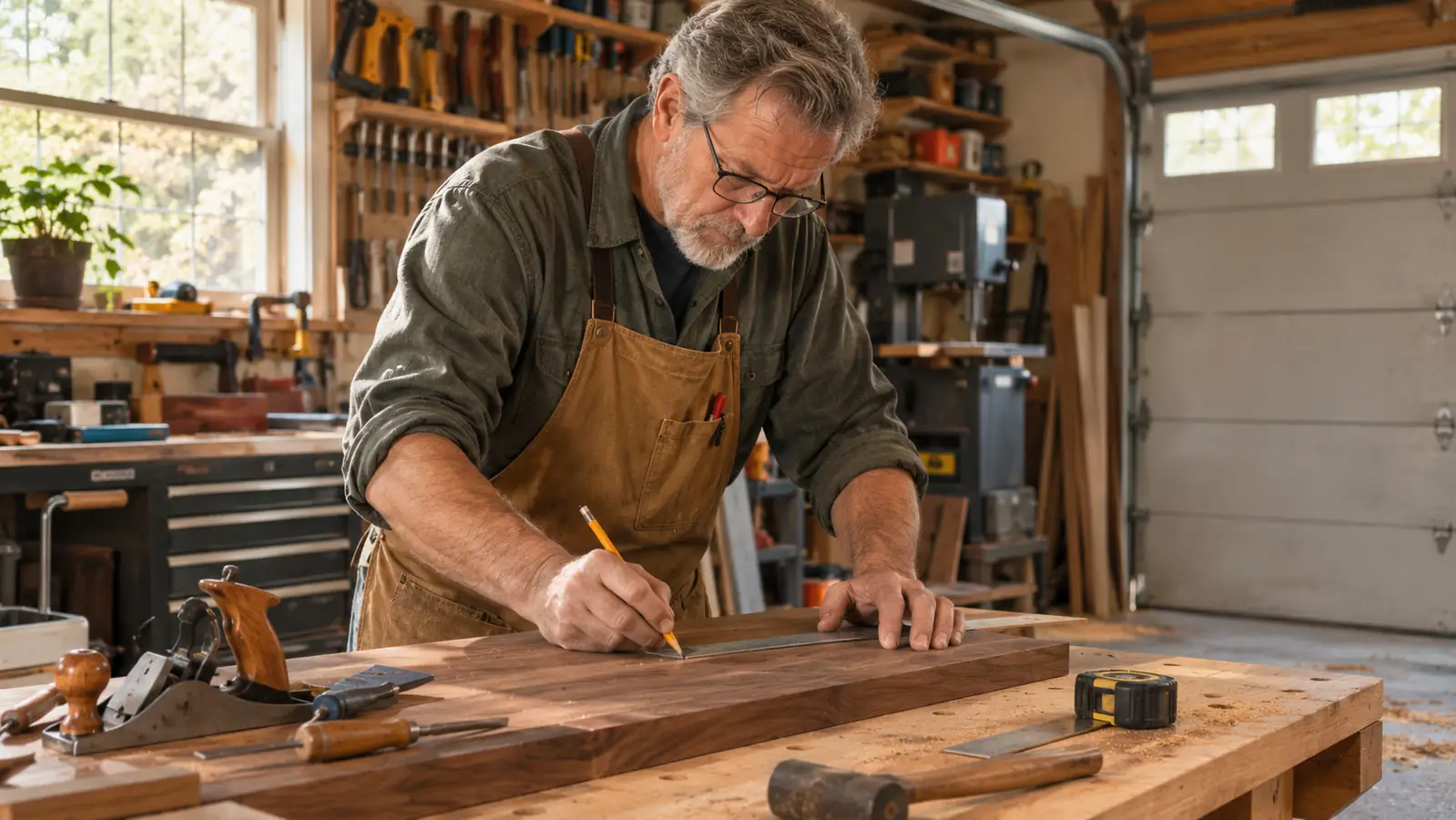
A tape measure tells you a number. It does not tell you where the pencil line goes. I learned that in my twenties on a cabinet face, where a tape and a speed square disagreed by a fat sixteenth and I cut to the wrong one. That was a short piece of maple that had been a long piece of maple. Thirty four years of finish carpentry later, retired now and building furniture in a two car garage outside Boise, I still keep a tape in my apron. But every layout line in this shop goes through a combination square, and for the last three years that square has been an IRWIN.
The tools I tried before it are the ones most people start with. A speed square is a good tool and I still reach for one to mark a stud, but it has a fixed 90 and a fixed 45 and nothing that slides. A tape flexes, and the hook on the end moves a hair on purpose, which means it is built to measure slop. The cheap plastic combination squares from the hardware store bin will get you through a Saturday and then the body wears and the blade rocks in it. I wanted a metal body, a stainless blade, and scales I could read without my glasses doing all the work. That is what this one is, and the IRWIN has been on my bench three years now.
The Quick Verdict
Three years of daily furniture layout from a 12 inch metal body square. It was true at 90 and 45 out of the box, the etched scales still read, and the knurled nut holds the blade if you check it before critical marks. Not a machinist square and it does not pretend to be.
Amazon Check Today's Price →The square that laid out a walnut table, a cherry bookcase and every end table since
12 inch stainless steel blade, metal body, black etched scales in 1/16 inch graduations, marks 90 and 45 degrees, and a sliding blade locked by a knurled nut that doubles as a depth and marking gauge.
Amazon Check Today's Price on Amazon →How I've Used It
I bought this square in the first winter after I retired, along with a set of chisels, a sharpening stone and a handful of small clamps, because I did not want to keep walking out to the garage and picking up beat up job site tools. That was three years ago. Since then the IRWIN has been the first thing I pick up on a project and usually the last thing I put down.
The cherry bookcase two winters ago is where it earned its place. Every shelf dado, every shoulder line on the face frame, every mark for the back panel came off this blade. I would set the blade to the depth I wanted, use the square as a depth gauge to score the line clear across the board, then come back with a knife and a chisel. When you score a line with a square instead of drawing it with a pencil, the chisel has a wall to sit against and the joint closes the way it is supposed to. A pencil line is a suggestion. A scored line is a wall. I did that on eleven shelves in that bookcase and did not lose a single board to a wandering line.
The shaker end tables this year were plainer work, and that is exactly why I noticed how much I lean on the tool. Four legs, four aprons, a top. Nothing fancy. But an end table is small enough that a degree of error at one corner shows up as a rock at the opposite one, and you feel it every time you set a glass down. I checked square off a single reference edge on each apron and transferred the mark rather than measuring from both ends. The tables sit flat. Nothing wobbles.
The walnut dining table for my wife Marit last winter is the project I would point to if you asked what a square is actually for. A table is all reference faces. You pick one edge, you make it straight, and then every other cut on that top has to come off that edge at exactly 90 degrees or the whole thing racks. I used the square to check the top corner to corner and to transfer the leg positions off the jointed edge. When the pipe clamps came off, the diagonals matched. That is not luck. That is a square you trust, and it is why I stopped treating layout as a chore and started treating it as the part that decides the project.
What the IRWIN Gets Right
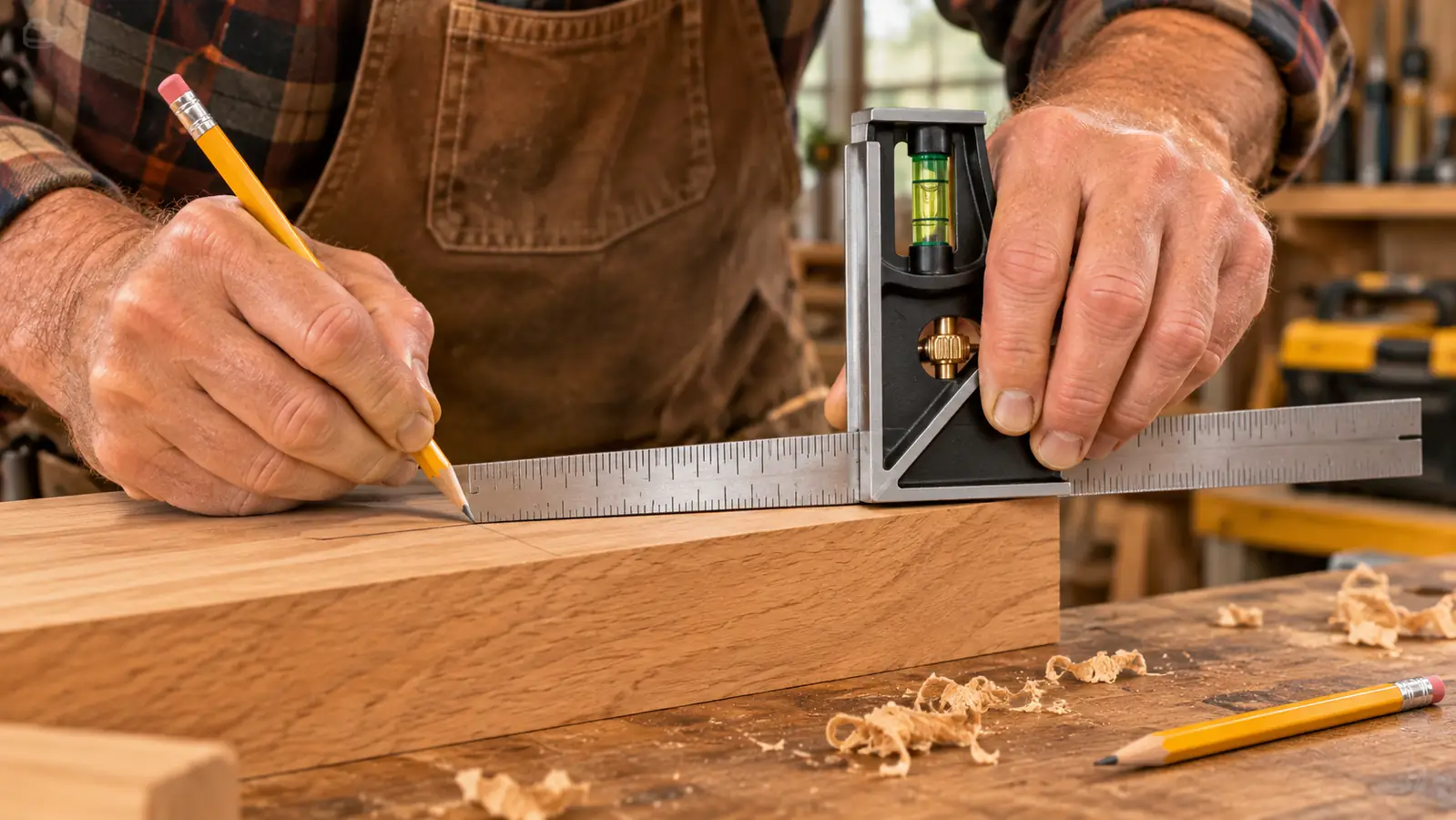
The blade is 12 inches of stainless steel, and the stainless is not a marketing line in an unheated garage in Idaho. I have had carbon steel tools rust from sitting through a cold damp spring without ever being touched. Three winters in this shop and the blade on this IRWIN has not spotted.
The scales are black and etched into the blade rather than printed on it. Printed scales wear off at the corner where your thumb rides, and that corner is exactly where you read from. The graduations are 1/16 inch, which is the right size for furniture. I do not need thousandths. I need to know whether I am on the line or a hair past it, and 1/16 marks are big enough to see in shop light without leaning in.
The body is metal and heavy enough to sit still. The listing puts the whole square at 14.4 ounces, and that weight is what makes it feel like a tool instead of a pattern. The blade slides in the body and locks with a knurled nut. That nut is the whole tool. Set the blade where you want it, spin the nut down snug with your thumb and forefinger, and the blade does not creep while you drag the square across a board.
The transferring part deserves its own mention because it is the thing that quietly saves lumber. When I have a mortise already cut and I need the same location on a mating piece, I do not measure it. I set the blade against the finished face, hold the body square to the edge, and mark straight off the existing joint. No number goes into my head, so no number can come out wrong. In twenty years of building furniture at home, that habit has saved me more boards than any other single technique. It is also the reason I stopped buying spares of every dimension.
The Flip Test, and Why I Ran It
The first thing I did when this square came out of the package was not a project. It was a test. I found a straight factory edge on a piece of plywood, held the body against it, and drew a fine line with a knife. Then I flipped the square over, put the body against the same edge, and drew a second line right on top of the first. If the tool is out of square, the two lines make a wedge. If it is true, you get one line.
My IRWIN gave me one line. I have run that check a couple of times a year since, usually after the square has taken a knock off the bench, and it has held. That is the honest limit of what I can tell you. A garage shop is not a metrology lab and I am not working in tenths. What I can tell you is that joints come out square and cabinets sit flat, which is the only test that matters to me at the end of a project.
The 45 degree side gets less attention than the 90, but it earns its keep. Chamfers on a table edge, mitered corners on trim, the occasional brace. I lay the 45 degree face of the body against the edge, lock the nut with the blade where I want it, and mark. I do not have to think about which way the body faces. That sounds small until the day you mark a miter backwards and cut it.
Where It Comes Up Short
The knurled nut works, but it is not self tightening. If I set the blade, use it, and set the square down hard on the bench, the blade can shift a hair. So I check it against the body with my thumb before every critical mark. That is a two second habit, and it is the difference between this tool being reliable and this tool being a source of scrap. I would rather tell you the habit than pretend the nut never moves.
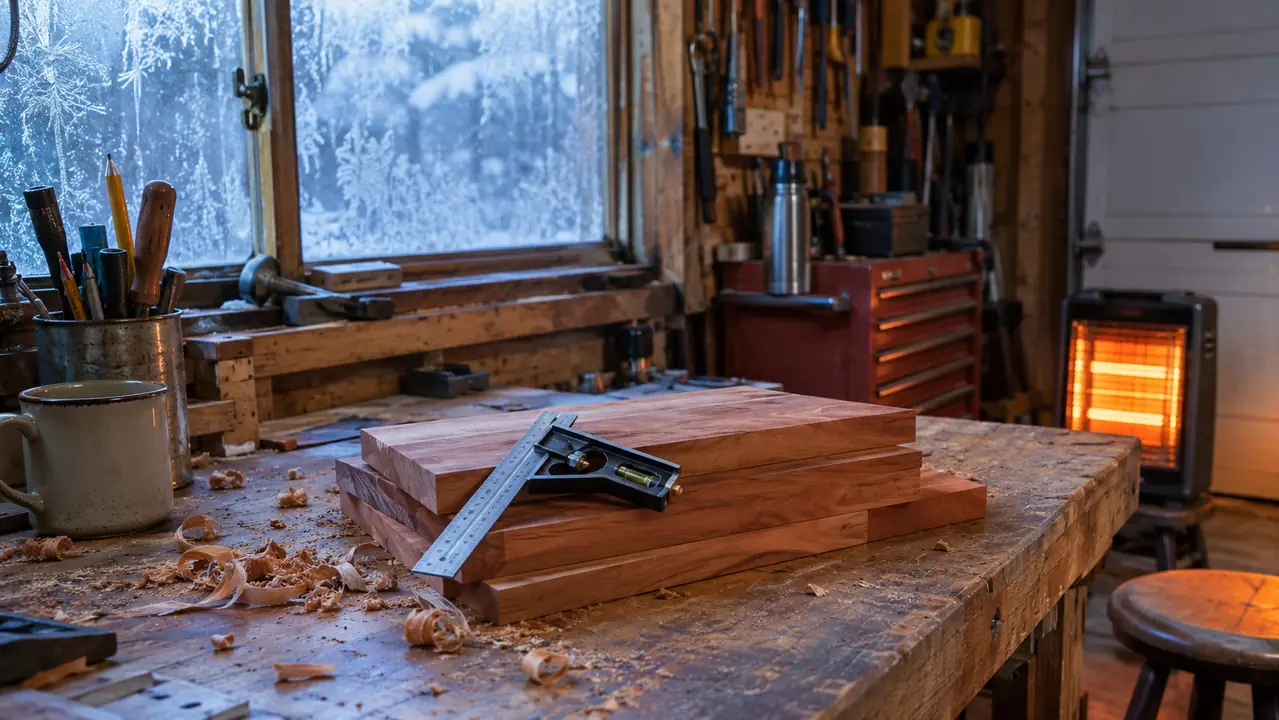
The scale is black on stainless, and a dim garage in January with one small electric heater running is not the easiest place to read black on grey. I have turned the blade toward the window more than once. In daylight it is fine. Under the bench light it is fine. It is not a high visibility scale and it was never sold as one, so do not buy it expecting the numbers to jump at you in the dark.
This is not a machinist square and you should not buy it expecting one. The body is metal and it is well made, but this is a general purpose square built for carpentry, not a precision instrument built for a toolroom. If you are setting up a machine and need to know you are within a thousandth, this is the wrong tool and you already know it. For furniture, where a sixteenth is a real unit and a thirty second is a decision you actually make, it is more than accurate enough.
The weight cuts both ways. At 14.4 ounces it is heavier than the little try square I carried for years, and in a tool belt on a ladder it is noticeable. In the shop that weight is an advantage because the body stays put while you mark. On a ladder it is a paperweight with a sharp corner, and I stopped carrying it up there years ago. If a ladder is where most of your work happens, think about that before you buy.
What I Liked
- True at 90 and 45 when new, confirmed with the flip test against a straight edge
- Stainless blade has not rusted through three winters in an unheated garage
- Etched 1/16 inch scales that do not wear away where your thumb rides
- Sliding blade locked by a knurled nut works as a depth gauge and a marking gauge
- 12 inch blade is long enough for cabinet and tabletop layout
- Metal body sits flat and steady on the bench while you mark
- Limited lifetime warranty from IRWIN
Where It Falls Short
- The knurled nut can let the blade creep after a hard set down, so check it before critical marks
- Black scale on stainless is dim reading in low winter light
- 14.4 ounces is heavy for a tool belt
- General purpose square, not machinist grade, so do not expect thousandths
- A drop onto concrete is worth a flip test before the next joint
If the tool is out of square, your two lines make a wedge. If it is true, you get one line. That is the only test I care about.
Who This Is For
This square is for the person who has figured out that measuring is not the same as laying out. If you are building furniture, hanging cabinets, trimming a room, or putting together a bench in a garage, and you have gotten tired of joints that close on one side and gap on the other, a 12 inch combination square with a metal body is the tool that fixes the cause rather than the symptom. It is also for the person who wants one square to do several jobs: 90 degree marking, 45 degree marking, depth checking, and transferring a measurement off a finished piece instead of trusting a tape.
It suits a beginner fine, which is worth saying plainly. There is nothing to adjust, nothing to calibrate, and nothing to plug in. You hold it against an edge, you lock the blade, you mark. The flip test takes ninety seconds and it teaches you more about why square matters than any article will. If you are just starting out and buying tools one at a time, this belongs early on the list, ahead of a lot of things that are more fun to buy. I would put it in the first five tools and not think twice.
Who Should Skip It
Skip it if you already own a machinist square and do precision machine setup. This tool is not that, and buying it as a second best version of that will leave you disappointed for reasons that are not the tool's fault. Skip it too if all you ever do is rough framing and you already carry a speed square you like. For cutting studs and marking plates, the speed square is faster and you do not need a sliding blade.
And skip it if you are the kind of person who will not check a knurled nut before a critical mark. The tool will hold its setting well, but it is held by friction and a thumb, not by a detent. If you want a square that never needs a glance before you trust it, spend your money on something with a fixed blade and accept that it will only do one job. I would rather have the sliding blade and the two second habit. Three years in, that trade has been the right one for me.
Three years in my shop and it still passes the flip test
12 inch stainless steel blade, metal body, black etched 1/16 inch scales, 90 and 45 degree marking, and a sliding blade that works as a depth and marking gauge. If your layout lines are the reason your joints gap, start here.
Amazon Check Today's Price on Amazon →