

I bought the Narex six-piece bench chisel set three years ago, in the first winter after I retired, and it is the hand tool purchase I would repeat first if I had to start the shop over. I want that on the record before anything else, because most of what follows is about the parts the listing does not mention, and I do not want you reading a list of caveats and thinking I regret the set. I do not. I just think a person about to spend an evening flattening six backs deserves to know that is what the evening looks like.
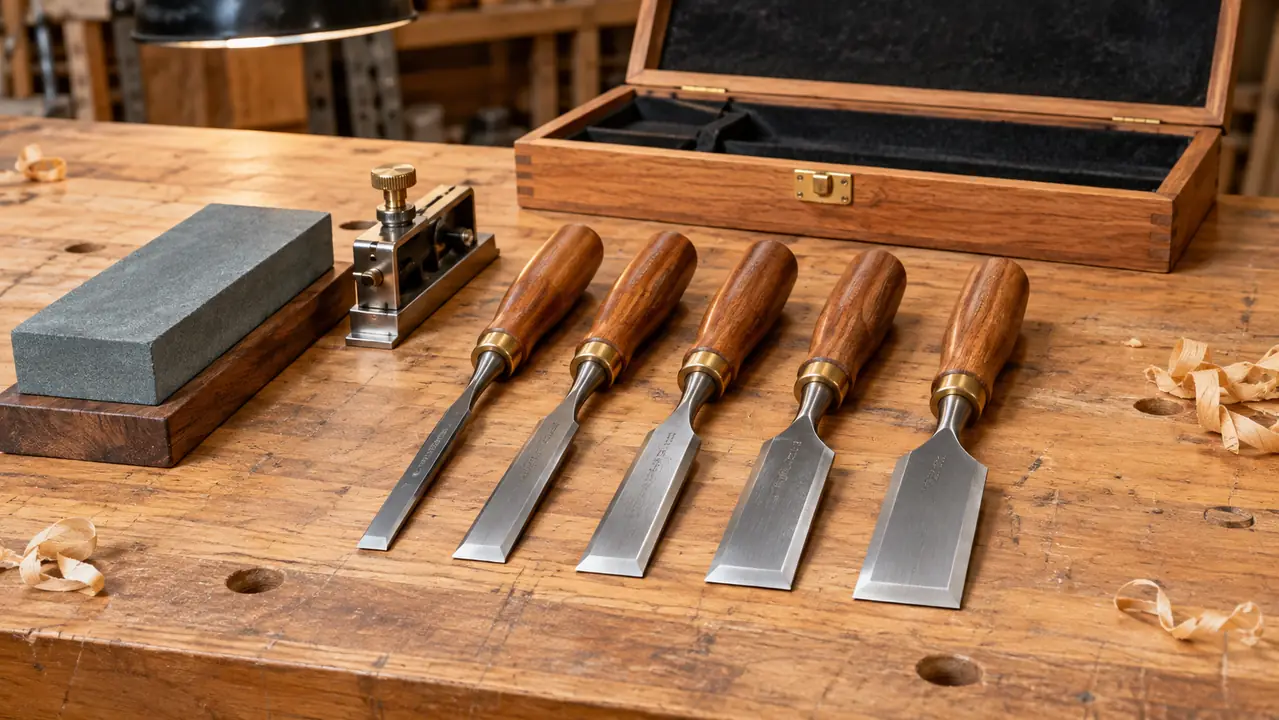
Here is what arrives. Six bevel-edge bench chisels in metric sizes, 6, 10, 12, 16, 20 and 26 mm, with blades of chrome-manganese steel hardened to Rc 59 and ground at a 25 degree bevel. The handles are stained European beech. The set comes in a wooden presentation box, weighs about 1.6 pounds, and the box measures roughly 6.37 inches by 13.5 inches, so it takes less shelf than you would guess from a six-piece set. Nothing about these is fussy or decorative. They are working chisels, and three years in the shop has not changed my mind about that.
The Quick Verdict
Six sizes that cover furniture work, steel that holds an edge through a full joint, and bare beech tops that demand a wooden mallet. The only real cost is the hour before your first cut.
Amazon Check Today's Price →The set I would buy again, after one honest evening of flattening
Bevel-edge bench chisels from 6 mm to 26 mm, chrome-manganese steel at Rc 59, stained beech handles, wooden box. Wooden mallet only. Plan an hour on the stone first, then get to work.
Amazon Check Today's Price on Amazon →How I've Used Them
Everything in my shop is furniture, not site work. I spent 34 years doing trim and cabinet installs and retired four years ago, so the home shop is a two-car garage with a concrete floor, a 240-volt circuit, and one small electric heater that does very little in a Boise January. Since the chisels came into the shop I have built shaker-style end tables, a cherry bookcase, and a walnut dining table for my wife, Marit. The Narex chisels do the paring and the chopping on all of it. Hinge pockets get mortised, dovetail waste gets cleared, tenon shoulders get trimmed, and the occasional lifted splinter gets pared off before glue.
I have never struck one of them with a steel hammer. Every chop goes through a wooden mallet. That is not me being precious about tools. These chisels have no steel hoops and no strike caps, so the top of the handle is bare beech, and a steel hammer will mushroom it in short order. Coming from a job-site set with capped handles, that is the biggest change in habit this set asks of you, and it is the change people ignore until a handle splits and they cannot work out why.
The work itself is not heavy. A chisel spends most of its life in a hand, not under a mallet. On a typical joint I might chop a few dozen times and pare a few hundred. What I have noticed over three years is that I reach for the middle sizes without looking, which is the sign of a set laid out sensibly and a sign of which chisels are actually earning their place. That is also the clearest thing I can tell you about the Narex set that a spec sheet cannot: the sizes are spaced the way a furniture maker actually works, not the way a catalog rounds out a row.
The Edge Out of the Box Is Ground, Not Sharp
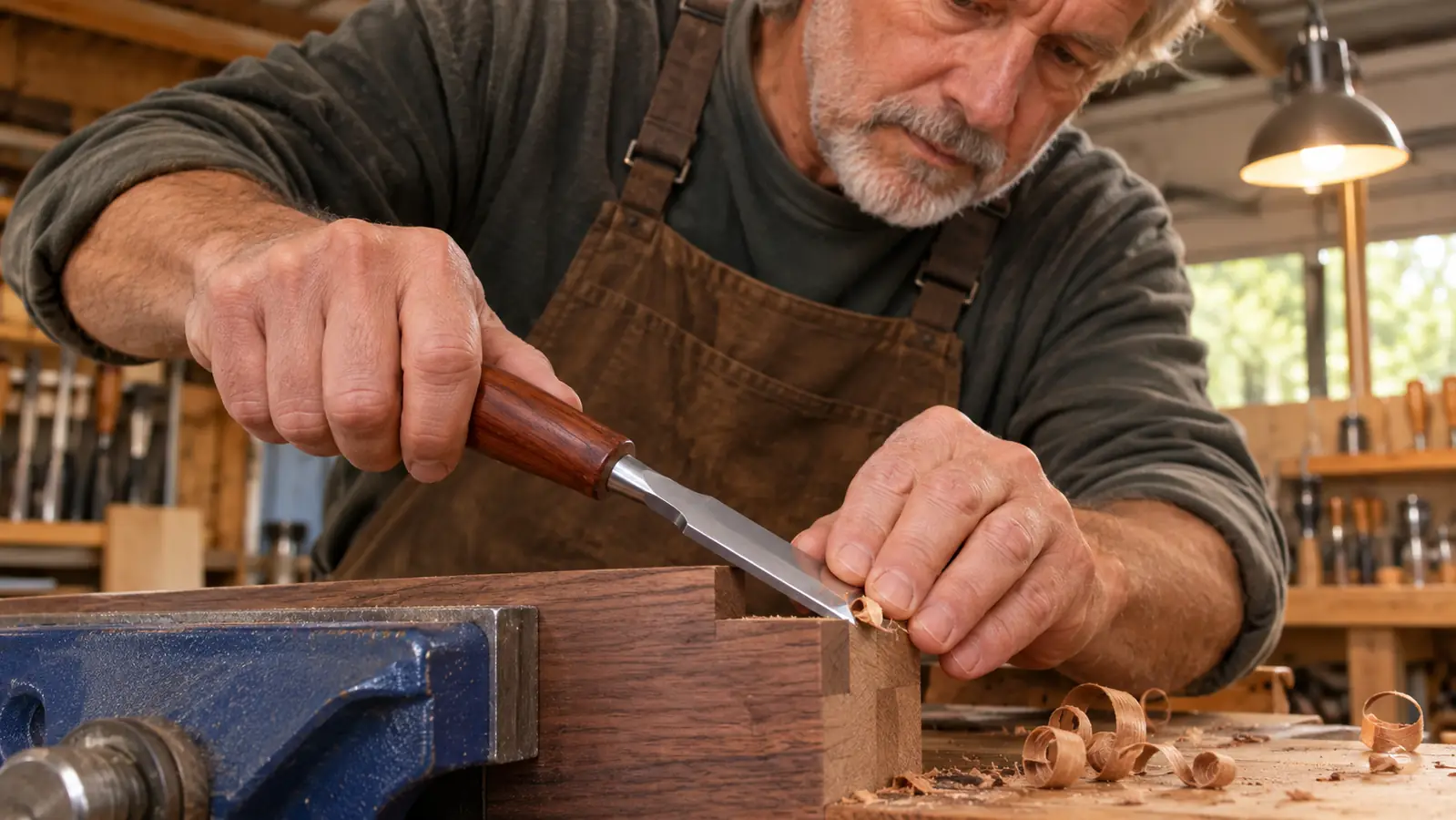
Nobody says this clearly enough, so I will. These arrive ground, not sharp. The back of each blade is not flat, and the edge is a grinding mark away from cutting wood properly. Out of the box you can raise a curl off a scrap and it will feel sharp enough that you think you are finished. You are not. A chisel that is sharp but not flat will not pare a straight line, because the back is your reference surface and the back is riding on its high spot.
Flattening the backs is the part nobody enjoys. I use the coarse side of a Norton combination oil stone, 8 by 2 by 1 inch, corundum, lubricated with a light honing oil and never water. The coarse side is 100 grit and it is meant for edge repair and for exactly this kind of work. I work each back until the scratch pattern runs the full width of the blade and reaches back from the edge, then I move to the fine side. If you skip this step, the chisel will feel sharp in your hand and still refuse to cut a flat shoulder, and you will blame your technique.
Then the bevel. These come ground at 25 degrees and I hone at 30, which puts a small micro-bevel at the tip and means I am polishing a sliver of steel rather than the whole face. A simple side-clamp honing guide holds the angle and I finish on a leather strop. I check the stone for flatness once in a while, because a dished stone will round a back over time and you will chase your own tail trying to work out why the edge keeps dulling. Six chisels took me about an hour that first evening. I have not had to flatten a back since, and honing is two or three minutes per chisel when one starts to drag.
A chisel that is sharp but not flat will not pare a straight line, because the back is your reference surface and the back is riding on its high spot.
Chopping and Paring Are Two Different Jobs
People talk about chisels as if they do one thing, and that is where a lot of disappointment comes from. Paring is a hand pushing a blade through wood, taking a shaving off a tenon shoulder or cleaning up the end of a groove. Chopping is a mallet driving the blade down into a mortise and then levering the waste out. The Narex set does both, but it does them differently, and the bevel edge matters far more for the first than the second.
The bevel edges are what let these chisels turn into the corner of a dovetail or lie flat in a dado without the shoulders of the blade stopping the cut. A square-edge chisel is stronger, and it cannot get into an acute corner. For furniture, bevel edge is the right call. It is also why my old hardware store chisels now live in a drawer and come out only for rough work, where it does not matter if an edge gets banged up on a nail or a knot.
Handles, Hoops and the Mallet Rule
The handles are stained European beech, and that is a sensible choice. Beech is dense enough to take a hit and it does not go slick in a warm hand the way a heavily finished handle can. They are comfortable over a long session at the bench. After three years the finish on mine has worn at the high spots where my palm sits, and I like that. It means the tool is doing what it was bought for.
What the handle does not have is a hoop. That means you strike wood with wood and nothing else. A wooden mallet is not a hardship once you are used to it, and it is easier on the wrist than a steel hammer over a long afternoon, but it is a rule you have to hold to even when the hammer is closer to your hand than the mallet is. The other thing worth knowing is that the top of the handle is where a chisel takes abuse when you are leaning on it to clear a mortise. Using the heel of your hand there is fine. Reaching for the claw hammer because it is nearer is how handles die.
Which Sizes Actually Get Used
Six sizes sounds generous until you have lived with them for a year and found out which two or three carry the job. The 12 mm and the 16 mm do most of my work. Those are the two that fit the width of a typical mortise and the two that are wide enough to pare a tenon shoulder flat without leaving tracks behind. If a project only needed two chisels, that is the pair I would carry to the bench.
The 6 mm and the 10 mm are for the small work: cleaning out the corners of a hinge pocket, paring a narrow groove, lifting a chip out of a dado. The 20 mm and the 26 mm are the wide ones, and the 26 mm is the one I reach for when I want one clean pass across a wide face instead of three passes that each leave a track. That is not every project. It is the one that makes you glad the set goes that wide instead of stopping at 20.
One thing to plan for: these are metric. If you work from imperial plans you will be converting in your head, and 12 mm is close to a half inch but close is not the same as the same. I keep a small card with the conversions taped inside a cabinet door and I stopped thinking about it after about a month. It is a small friction, not a real problem, but it is the kind of thing that annoys people who did not expect it.
What Three Years in the Shop Looks Like
Nothing has failed. No handle has loosened, no blade has chipped in a way that mattered, and none of them has needed more than routine honing. The steel holds an edge about as long as I would expect from chrome-manganese hardened to Rc 59. It is not the hardest steel you can buy, and I would not want it to be, because harder steel takes longer to bring an edge back on an oil stone. I touch one up on the Norton stone and I am back to work in a couple of minutes, which is the trade I want in a home shop where nobody is paying me by the hour.
The wooden presentation box has held up fine and it lives on a shelf under the bench. I would not call it a storage solution for a working shop, because you lift the chisels out one at a time rather than pulling one off a rack. Some people throw the box out and build a wall rack, and I understand why. I kept mine because it stops the edges knocking against each other in a garage where things get moved around, and that matters more to me than convenience.
If you are weighing the Narex set against the chisels on the shelf at a hardware store, the difference is not one you notice in the first ten minutes. It is a difference you notice in the fourth hour of a dovetail session, when the hardware store blade has needed three trips to the stone and the Narex chisel is still taking a clean shaving. I still own both. The old ones get used where there might be grit or a hidden staple in reclaimed stock. That is a fair job for them, and it is not the job I bought the new set to do.
What I Liked
- Steel takes a fine edge and holds it through a full joint, not just a few paring cuts
- Six metric sizes cover hinge pockets through wide paring, with 12 mm and 16 mm doing most of the work
- Beech handles stay comfortable over a long session and wear in rather than out
- Bevel edges turn into dovetail corners and lie flat in a dado, which a square-edge chisel will not do
- Three years of furniture work with no loosened handle and no chipping that mattered
Where It Falls Short
- Not sharp out of the box. Backs need flattening and edges need honing before the first joint
- No hoops and no strike caps, so a wooden mallet is the only thing that should touch the handle
- Metric sizes mean converting in your head if your plans are in inches
- The box is for presentation and shelf storage, not a working wall rack
Where the Set Falls Short
The honest answer is that nearly all of the shortcomings sit at the front end. An hour of flattening and honing, plus a habit change about the mallet. Once you are past that, there is not much to complain about in ordinary furniture work. Where I would send you elsewhere is if you chop hard and often. The bare beech top is a real limitation in that case, and what you want is a hooped handle with a strike cap that can take a hammer all day without complaint.
The other limit is the size range. Six to 26 mm covers furniture. It does not cover timber framing, and it does not cover the very fine work that a narrow chisel gets into on small boxes and inlay. If your projects run that way you will be buying a narrower chisel separately, and that is fine, but this set will not be the last chisel purchase you make. No set is, and anyone who tells you otherwise has not been at this long.
One more thing I would have wanted to read before buying. The Narex box is a nice box, and it is still a box. Nobody's joinery improves because the chisels arrived in something handsome. If the packaging is what tips your decision, wait a week and see whether you still want the set for the steel.
Who This Is For
This set is for the person building furniture in a home shop who wants a full range of bench chisels that will do real work and does not mind spending an evening getting them ready. If you are cutting dovetails, mortises, hinge pockets and paring tenon shoulders, and you accept that a wooden mallet is part of the arrangement, these will serve you for years. It suits somebody who would rather learn to sharpen once than buy a fresh chisel every time one goes dull, because the sharpening is where the value sits.
Who Should Skip It
Skip it if you want to open a box and start cutting the same afternoon. Skip it if your work is rough framing or site carpentry where a chisel gets hit with whatever happens to be in your hand. Skip it if you have no way to sharpen, because a dull chisel and no stone is a dead end no matter how good the steel is. And skip it if you are buying your first chisel and have not yet decided whether hand tool work is for you. Two individual chisels and a stone would teach you more, with less commitment, and you would know by spring which way you want to go.
Six chisels that earned their shelf space, once I flattened the backs
Bevel-edge, 6 mm through 26 mm, chrome-manganese steel at Rc 59, stained beech handles in a wooden box. Buy the mallet, plan the evening on the stone, and they will outlast the projects you bought them for.
Amazon Check Today's Price on Amazon →