

The stone on the shelf under my bench is not the newest tool in the shop, and that is exactly why I trust it. I bought the Norton combination oil stone three years ago, in the first winter after I retired from finish carpentry, along with a set of Narex chisels, an IRWIN combination square, and a pack of mini clamps. After 34 years of trim and cabinet installs, I wanted a home sharpening setup that did not depend on the habits I had built on job sites. The Norton stone has been part of every chisel and plane iron I have sharpened since, through a cherry bookcase, a walnut dining table for my wife, Marit, and more cutting boards than I can count.
I am 61 now. Marit and I live outside Boise, Idaho, where I build furniture in a two-car garage shop. The floor is concrete, the winters are cold and dry, and the shop is unheated apart from one small electric heater. I have one of each major machine: a contractor table saw, a 14 inch band saw, a benchtop planer, and a drill press. The hand work is where the Norton stone earns its place. It sits on a shelf, not on a machine, and it is the first thing I reach for when an edge starts to feel dull.
The Quick Verdict
A dependable bench stone for chisels and plane irons. The 100 grit coarse side handles nicks and bevel resets, and the fine side leaves an edge that cuts end grain cleanly. It is not fast, it needs oil, and it will not replace a grinder. For a home shop that sharpens regularly, it has held up for three years.
Amazon Check Today's Price →The Stone I Have Kept on the Shelf for Three Years
If you sharpen chisels or plane irons at home, the Norton combination oil stone is the one I reach for. Check the current listing and today's price on Amazon.
Amazon Check Today's Price on Amazon →How I've Used It
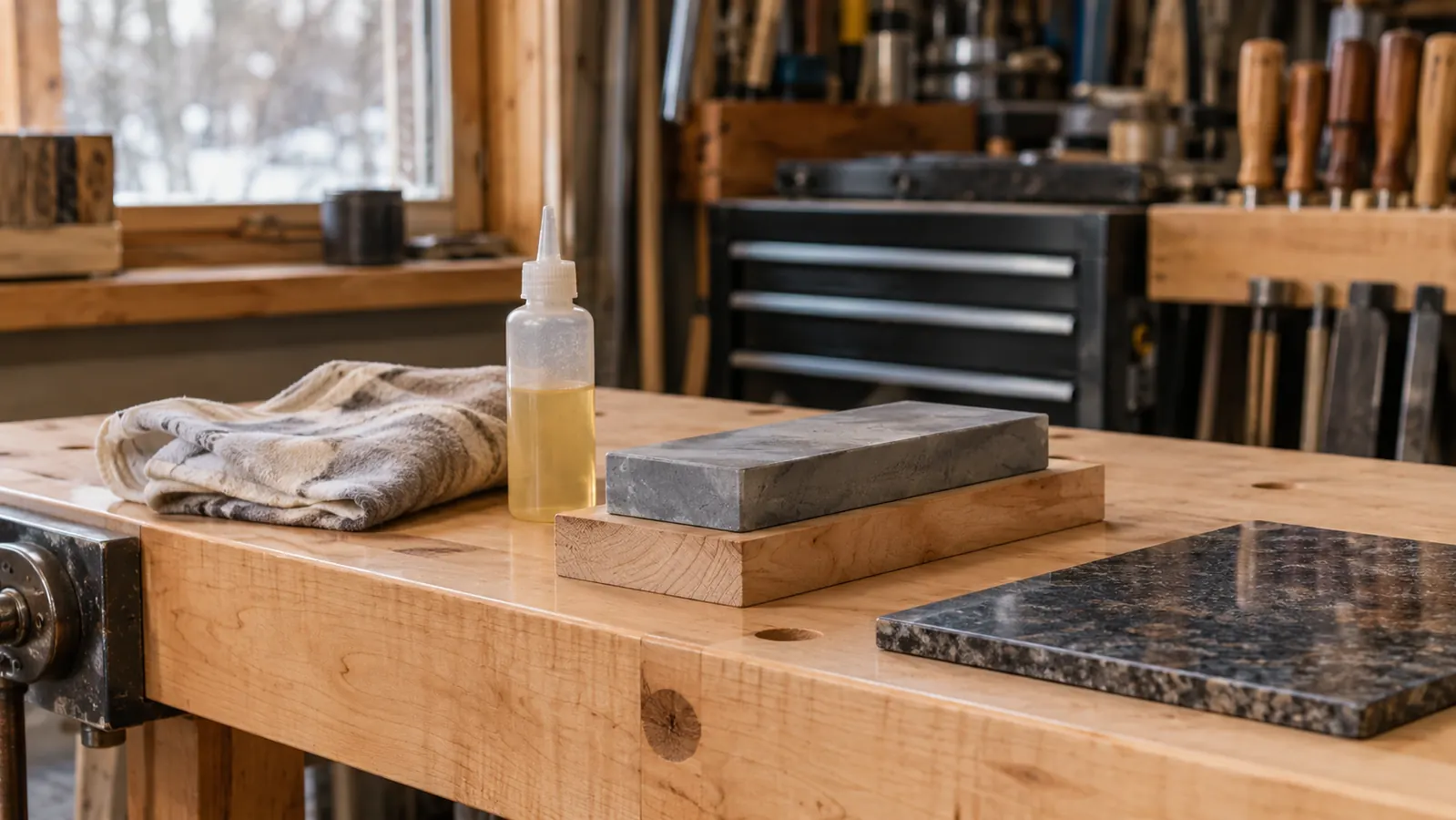
I keep the Norton stone on a shelf under the maple workbench I built, next to a small bottle of light honing oil and a side-clamp honing guide. I never use water on it. Oil is what the stone wants. Oil carries the metal swarf off the surface and keeps the abrasive from loading up. I put a few drops on the stone, spread them with my finger, and work the edge until the oil turns dark. Then I wipe the stone with a rag and put it back.
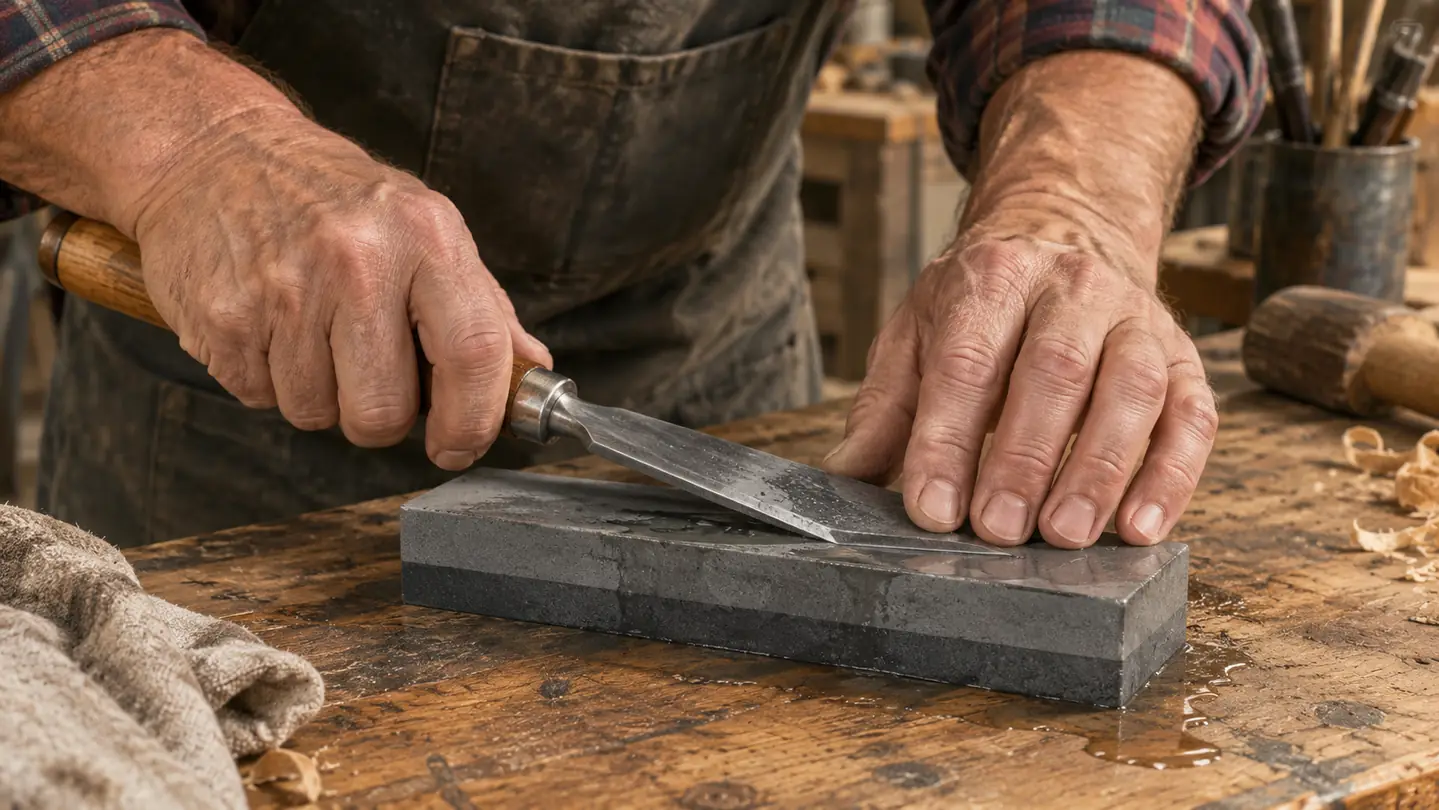
The routine is simple. I set the chisel in the guide, set the bevel on the stone, and hone at 30 degrees on the 25 degree bevel. If the edge is in good shape, I start on the fine side. If it has a nick, I start on the coarse side and take my time. A few passes with light pressure, then a check with my thumb, then the fine side, then a leather strop. Plane irons get the same sequence, only longer. The stone is 8 by 2 by 1 inch, so a 2 inch iron has room to travel without hanging off the end.
Two winters ago I was cutting the joinery for the cherry bookcase and caught a knot on the far side of a 16 mm chisel. It left a nick I could feel with a fingernail. I did not reach for a grinder. I put a few drops of oil on the coarse side, set the chisel in the guide at 30 degrees, and worked it in slow passes, rolling the chisel slightly so the nick met the stone evenly instead of digging in at one spot. It took somewhere around forty passes before the nick was gone and the bevel was even again. Then the fine side, then the strop, then back to the bookcase.
I check the stone for flatness once in a while. Three years of use has not turned it into a hollow, but I still check. I wipe it down after each session and put it back on the shelf. That is the whole maintenance routine. No soaking overnight, no grit progression, no holder with a bunch of adjustments. The stone and the oil and the guide are enough. I have sharpened the Narex chisels and the irons from my bench planes on this stone, and I have never felt the need to add another stone to the shelf.
What the Two Sides Actually Do
The coarse side is 100 grit. That is not a number that impresses anyone who has used a grinder, and it should not. It is the side I use when a chisel has a nick or when I am resetting a bevel after a bad encounter with a knot. A dozen or so passes with light pressure will get the edge back to something the fine side can finish. It is not fast. If you have a chisel with a serious chip, you will be there for a while. But for the small nicks that happen in normal use, it does the job.
The stone is 2 inches wide, and that matters more than it sounds. My widest Narex chisel is 26 mm, right about an inch, so it sits fully on the stone with room to spare. I can work it straight back and forth without the edge dropping off the side and rounding over. A narrow stone would have me fighting to keep the bevel flat. The 8 inch length gives me enough runway to use both hands, one on the guide and one steadying the chisel, and the 1 inch thickness keeps my knuckles clear of the bench.
The fine side is the one that does the daily work. I cannot give you a grit number for it because Norton does not list one on this stone, and I am not going to guess. What I can tell you is that it leaves an edge that cuts end grain on cherry without tearing it. That is the standard I care about. I have used it on the Narex chisels after the coarse side, and I have used it on plane irons that only needed a touch up. It is fine enough for the final honing, and it is not so fine that it takes forever.
The stone is corundum, and it weighs 1.5 pounds. It sits still on the bench without a holder, which is more than I can say for the worn hardware store stone I used for years. That old stone rocked and chattered. The Norton stone stays put. I still keep the old hardware store chisels for rough work, but I do not sharpen them on the Norton stone unless I have to. The stone is reserved for the tools that cut joints and finish surfaces.
What Three Years Did to the Stone
The stone has not stayed new, and it should not. The surface has darkened from oil and metal. The edges have rounded slightly from handling. The coarse side cuts a little slower than it did on the first chisel, which is normal. I have not dressed it with anything more aggressive than a flat plate and a sheet of wet-or-dry paper once, and that was more for my own peace of mind than for the stone's performance. I checked it for flatness afterward and went back to work.
I check flatness with a steel straightedge I keep in the bench drawer. I lay it across the stone in three places, lengthwise and corner to corner, and look for daylight underneath. Three years in, I find a little light at the very ends, about the thickness of a sheet of paper, and nothing in the middle. That is not enough to throw off a bevel. If it ever got worse I would lap the stone on wet-or-dry paper on a flat plate, the same way I flattened the backs of the chisels when they were new and needed an hour of work before they were ready.
What has changed is my technique. Three years ago I leaned on the stone too hard. I wanted the edge now. The Norton stone taught me to use lighter pressure, to let the abrasive do the work, and to check the bevel with my thumb before I moved to the strop. That is not a feature of the stone. It is what happens when you use one stone long enough to learn it. I sharpen the chisels for a project, put them back in the box, and do not think about the stone again until the next project.
The stone has also been through cold winters. I keep it in the garage, and the garage gets cold. I have not seen a crack or a chip. I warm the shop before I sharpen, mostly for my own comfort, but also because oil gets thick when it is cold. The stone does not seem to care. I have used it in the winter for the shaker-style end tables I am building this year, and it behaved the same as it did in the summer.
The Norton stone taught me to use lighter pressure, to let the abrasive do the work, and to check the bevel before I moved to the strop.
Diamond Plates and Other Alternatives
Diamond plates are faster. I used them at a woodworking class, and they cut a chisel back to flat in less time than the Norton stone. They also stay flat and do not need oil. But they are loud, they can leave a scratch pattern that takes more work to remove, and they are not the same feel. I did not buy one because I already had the Norton stone and because I sharpen at a bench, not at a machine. For a home shop that sharpens a few chisels and plane irons a month, the Norton stone is enough.
The worn hardware store stone I used before was a different story. It was dished, it rocked, and it loaded up. Sandpaper on glass was flatter, but it was a consumable, and I went through sheets on a single chisel. The Norton stone replaced both. It is not the only way to sharpen. It is the way I settled on. I still have the pipe clamps and the old chisels, and I still use sandpaper for rough flattening, but the Norton stone is the one that stays on the shelf.
Where It Falls Short
This is not a fast sharpening system. If you are used to diamond plates, the Norton stone will feel slow. The coarse side is 100 grit, and it is not a substitute for a grinder when a chisel has a serious chip. I have used a coarse diamond plate at a woodworking class, but I do not own one. At home, I use the Norton stone and accept that resetting a bevel takes a few minutes. That is fine for a hobby shop. It would not be fine for a production shop.
Oil itself is not fussy, but it is a step. I use a light honing oil, a few drops at a time, and I add more when the surface starts to look dry rather than flooded. Too much oil and the chisel skates. Too little and the stone loads and the edge drags. I keep a rag folded on the shelf and wipe the stone down when I am done. In the cold months I bring the oil into the house the night before, because thick oil does not spread and you end up with a dry patch in the middle of the stone.
The stone also requires you to check flatness. It is a bench stone, not a permanently flat reference surface. I check mine once in a while, and I would expect anyone who uses it regularly to do the same. That is a maintenance step, not a defect. The fine side has no published grit number, which bothers some people. I stopped worrying about the number after the first chisel. The edge tells me what I need to know.
What I Liked
- Two useful sides: 100 grit coarse for repairs, fine side for honing
- Stays put on the bench at 8 by 2 by 1 inches and 1.5 pounds
- Corundum abrasive holds up to regular chisel and plane iron work
- Simple oil routine, no soaking
- Has stayed flat enough for three years of home shop use
Where It Falls Short
- Slow compared with diamond plates
- Requires light honing oil, not water
- Fine side has no published grit number
- Needs occasional flatness check
- Not a substitute for a grinder on badly damaged edges
Who This Is For
Someone who sharpens chisels or plane irons at home and wants one bench stone that covers repairs and honing. It suits a woodworker who is willing to use oil, check flatness, and learn a consistent angle. It is also a good fit for someone who has been using sandpaper on glass and wants a stone that stays put. If you build furniture in a garage shop, as I do, it is enough stone for the work. You do not need a rack of stones. You need one stone you understand, and this one is easy to understand.
Who Should Skip It
Skip it if you want a mirror edge in five minutes, if you refuse to use oil, or if you sharpen badly chipped edges every week and need a grinder. Skip it if you need a published grit number for the fine side before you trust it. And skip it if you are looking for a system that does everything without you learning the angle. This stone rewards attention. If you want fast and mindless, buy a diamond plate instead.
A Simple Bench Stone That Has Earned Its Shelf Space
The Norton combination oil stone is not the fastest way to sharpen. It is the one I have trusted for three years of chisels, plane irons, and furniture work. Check the current listing and today's price on Amazon.
Amazon Check Today's Price on Amazon →