
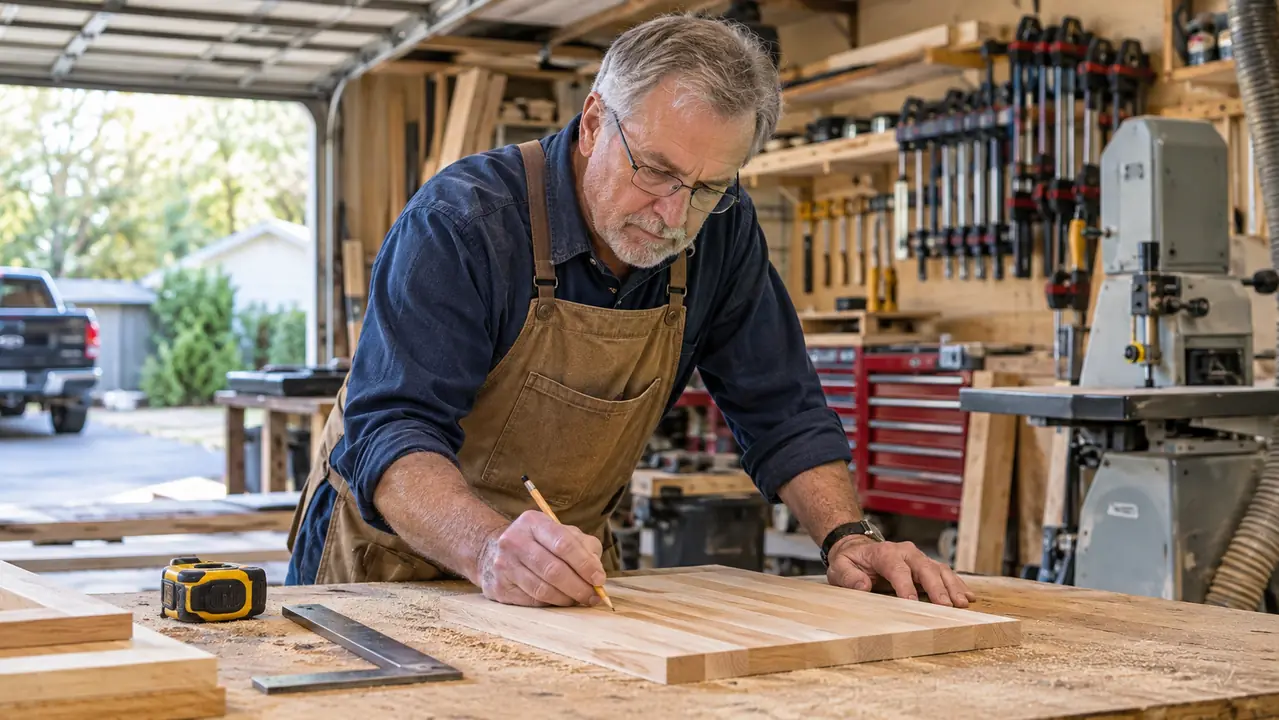
Short answer first. For furniture layout, the IRWIN combination square does more of the work, and it is the one I would buy again. I picked mine up three years ago, in the winter after I retired, when I rebuilt my hand tool kit so I would stop dragging job site tools into the garage. The speed square stayed. It is faster for framing, decking and breaking down stock, and I still reach for it most days. But when I am marking joinery on a cherry rail or checking a cabinet carcase for square, the combination square is the tool in my hand.
The difference between the two comes down to one thing. A speed square is built on fixed angles. Set the fence on the edge of a board and you have your 90 or your 45 with no adjustment at all. A combination square is built on an adjustable blade. The blade slides through the metal body and locks where you put it with a knurled nut. One tool is fast and the other holds a setting, and that single difference decides which tool suits which job. It is also why a shop that builds furniture ends up wanting both, even though only one of them earns a permanent place on the bench.
| IRWIN Combination Square | Speed Square | |
|---|---|---|
| Setting up | Blade slides in the body and locks with a knurled nut | Nothing to set, the angles are fixed in the casting |
| Marking a 90 across a wide part | 12 inch stainless blade spans a shelf or a rail in one pass | Short fence checks a corner, not the full width |
| Cutting a 45 | Body marks 45 degrees, but the setting has to be loosened and swung | 45 is built into the triangle, no adjustment at all |
| Transferring a measurement | Sets to a depth and works as a marking gauge | No sliding blade, so no depth setting |
| Matching a set of parts | One locked setting carries across every part in the run | Fixed angles only, other dimensions come off a tape |
| Degree and rafter work | Marks 90 and 45 degrees, that is the full range | Degree scale and rafter tables on the body |
| Bench or tool belt | 12.4 inches long, 14.4 ounces, lives on the bench | Drops into a pocket or hangs on a belt |
| Best for | Furniture joinery, cabinet parts, checking a carcase | Framing, decking, breaking down rough stock |
Where the IRWIN Combination Square Wins
The blade slides, and that matters more than it sounds. When I lay out a set of drawer parts, I set the blade to the offset I want, tighten the knurled nut, and mark all eight sides off the same setting. The number cannot drift, because I never have to re-read it off a tape. A speed square gives you the angles it gives you, and every other dimension comes off a tape and a pencil mark, which is where small errors work their way into a project. On the shaker end tables I built this year, every rail and stile came off one locked setting, and the parts went together without me having to talk myself into believing the joints were even. The aprons on those tables were planed to 7/8 inch thick and the shoulders sat 3/8 inch back from the face, which meant every one of them had to be marked off the same number. I set that blade once on a Tuesday morning and did not touch the nut again until Saturday. Four aprons and four rails across two tables. By the last rail I was not measuring anything at all, just pressing the body against the face and pulling a line. That is the part that saves you. Not the speed. The fact that the last part in the run is laid out to the same number as the first one.
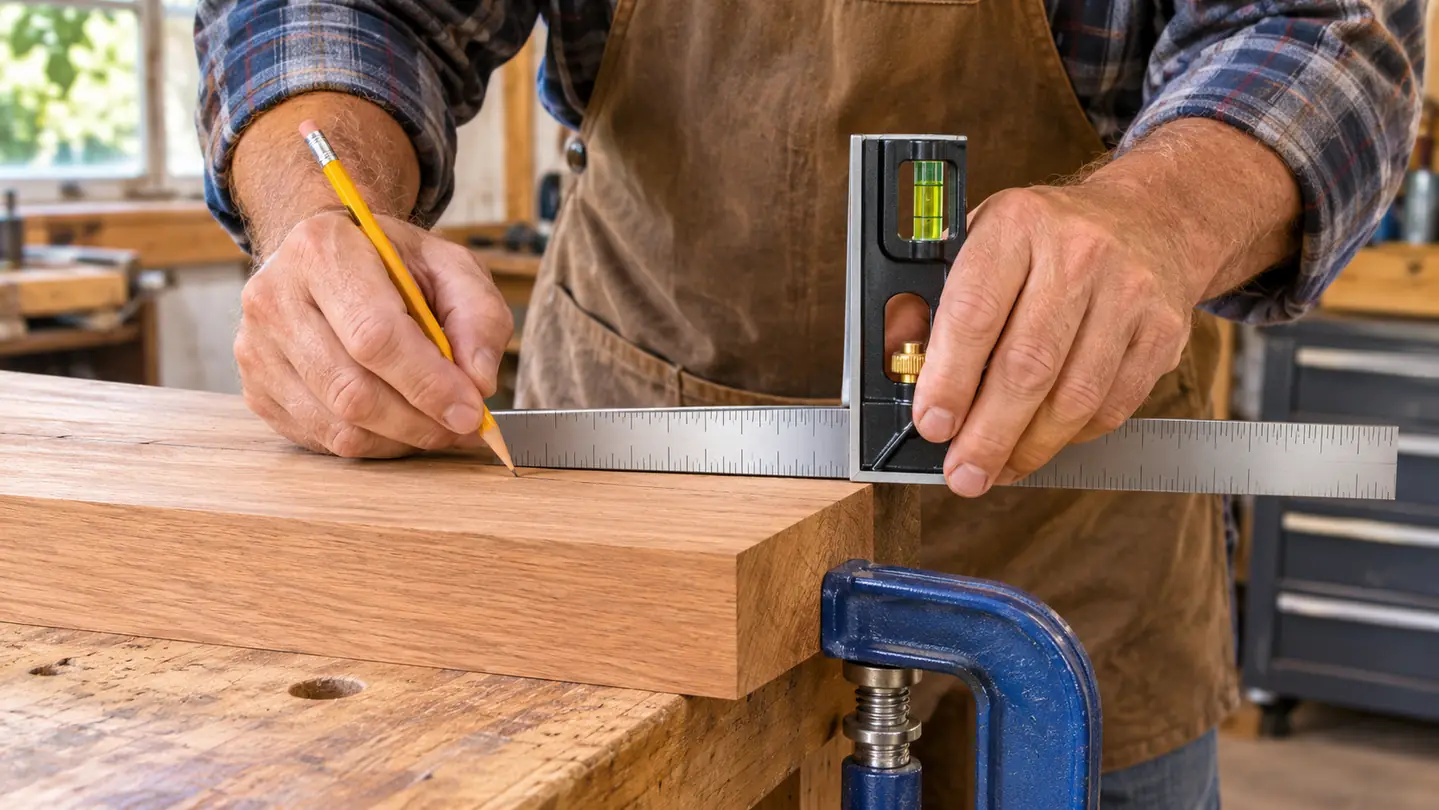
Then there is reach. The IRWIN blade is 12 inches of stainless steel with black etched scales graduated in 1/16 inch, and the body adds a little more on top of that. Laying it across the end of a bookcase shelf checks the full width in a single pass. A speed square covers a short span, so on a wide part you are checking one corner and hoping the rest followed. When I clamp up a panel I want the whole end checked, especially on a walnut glue-up where the parts cost too much to be guessing at.
It also works as a gauge. Set the blade to a depth and you can transfer that measurement to another part, or mark a line a fixed distance in from an edge without a ruler in the way. I use that on mortise layout and for setting a marking gauge off a sample piece. A speed square does not do this. It is an angle tool first and a straightedge second, and there is no shame in that, it is just a different job.
Where the Speed Square Wins
Speed, plainly. A speed square sits on the board with its fence hooked over the edge and your pencil runs down the blade. No loosening, no setting, no checking against a scrap. When I am breaking a board down to rough length, or cutting a dozen pieces of blocking, that is the tool I want, and it stays put with one hand while the other hand holds the pencil. On a board balanced across the saw horses, that one-handed control is worth more than any amount of precision you cannot reach.
It also does angles the IRWIN combination square cannot. Mine carries a degree scale and rafter tables, so an angled leg or a splayed bracket comes straight off the tool. The combination square marks 90 and 45 degrees and that is the whole set. For trim work or framing that is a real limit, and I am not going to talk around it just because I prefer the other tool for furniture. I met that limit plenty in my working years, cutting angled returns and setting stair stringers, and it is why the speed square was always in the pouch and not in the truck. In a furniture shop I meet it less often. A splayed leg or an angled bracket still turns up now and then, and when it does the speed square comes off the bench because there is nothing else in the drawer that will give me six or eight degrees off a face.
And it goes in a pocket. The combination square is 12.4 inches long and weighs 14.4 ounces, which is fine on a bench and clumsy halfway up a ladder. The speed square was one of the few layout tools I kept when I stopped working for other people, and I have never once thought about replacing it.
One Square That Holds the Setting You Gave It
The IRWIN combination square is the layout tool I pick up first on every furniture part in the shop. Twelve inches of stainless blade, black etched scales in 1/16 inch graduations, 90 and 45 degree marking, and a knurled nut that keeps the blade where you put it.
Amazon Check Today's Price on Amazon →Laying Out a Rail: One Tool Each Way
Here is how the two actually divide a job. Take a cherry rail for an end table, already jointed and planed, roughly 22 inches long. With the speed square I hook the fence over the face edge, mark the rail to rough length, and cut it. That takes less time than reading this paragraph. Then the part comes back to the bench and the combination square takes over. I set the blade to the shoulder offset, lock the nut, and mark the tenon shoulders from both faces so the lines meet on the edges. That second stage is slower, and it should be. It is the stage where a mistake costs you a piece of cherry instead of a piece of scrap.
On the speed square side of that job, there is nothing to think about, which is the point. On the combination square side, the tool is doing the remembering for me. I walk away, come back after lunch, and the blade is still at the setting I left it at because the knurled nut holds it. A tape measure will not do that. A pencil mark will not survive a hand plane passing over it. That is the whole case for the combination square in furniture work, and it is a strong one.
How the Two Tools Split the Work in My Shop
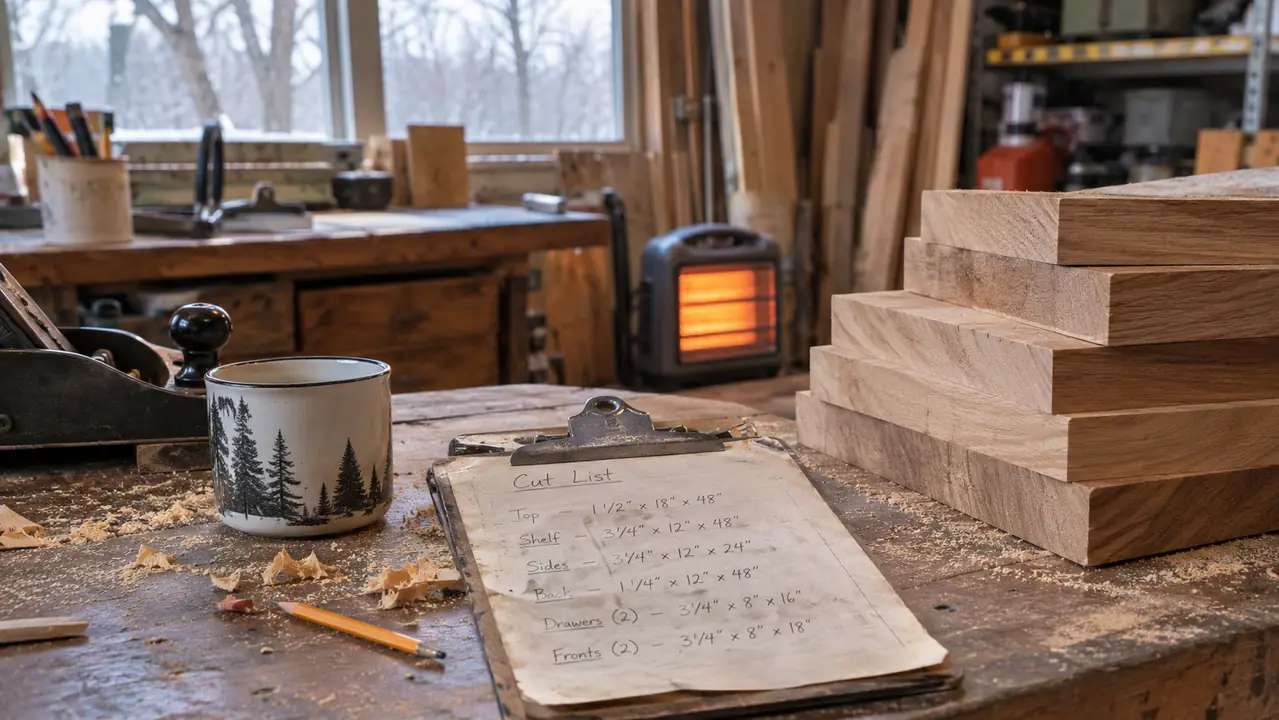
In practice they do not compete. The speed square gets stock broken down to rough length. The combination square takes over once a part is close to final and the joinery starts. On the cherry bookcase I built two winters ago, every shelf and side was marked with the combination square, and every board was cut to rough length first with the speed square sitting on the edge as a guide. Neither tool was ever in the wrong place at the wrong time.
One habit is worth building if you go this route. When I set the combination square for a dimension, I mark that setting on a scrap of the same stock and leave it on the bench until the parts are done. If I bump the blade, I have a reference to reset against instead of trusting my memory. That scrap has saved me a drawer front more than once, and it costs nothing but a piece of offcut and thirty seconds. The scrap stays at the back of the bench with the setting lines facing up so I can read them without picking it up. On the end tables this year that piece of cherry sat there for a week and a half while I worked through the rest of the run, and I set the blade against it twice, once after I knocked the square off the bench with my forearm. Both times the blade had moved. Both times I caught it before it cost me a part.
How I Checked the Combination Square Before I Trusted It
A square that is out is worse than no square at all, because it teaches you bad habits that show up three projects later. When the IRWIN arrived, I checked it the way I check any square. I held the body against a known straight edge and drew a line along the blade. Then I flipped the square over, set the body back on the same edge, and drew a second line right on top of the first. If the tool is true, the two lines are one line. Mine was true, which is what I expected and still worth the two minutes.
The other half of trusting a square is knowing what it does after a bad day. Mine slid off the bench onto the concrete two winters ago, right in the middle of laying out the bookcase, and the first thing I did was pick it up and run the flip test before I picked up a pencil. Two lines on top of each other, same as the day it came out of the package. The body is a metal casting and the blade is stainless steel, and from the state of the corners after three years, neither one has been coddled.
I run that check once a season now, and any time the square takes a fall. The body is metal and the blade is stainless, so it tolerates a working shop with a concrete floor and a small electric heater that never quite keeps up in January. It is not a machinist tool and I do not treat it like one. It is the thing I use to mark a door rail and check a carcase, and it has held up to three years of that without going out.
Who Should Buy Which
If you are building furniture, buy the combination square. That is the short of it. A person making a bookcase, an end table or a dining table spends most of their layout time on repeatable dimensions and on checking parts for square, and that is exactly what a combination square does and a speed square does not. You want the sliding blade, the knurled nut, and the full reach across a shelf or a rail. You will use it on every part of every project, which is not something you can say about many tools.
If your work is mostly framing, decking or breaking down sheet goods, the speed square is the better first purchase. It is faster, it handles the angles, and it fits in a pocket. If you already own a speed square and you are moving from rough carpentry into furniture, the combination square is the next tool to add, and it is the one I would spend the money on before a nicer tape or a second pencil. That is the order it happened in my own shop, and I would do it the same way again if I were starting over at 61 with a two-car garage and a stack of rough lumber.
I drew a line along the blade, flipped the square over, and drew a second line right on top of the first. Mine was true.
The Layout Tool I Would Replace First
Three years of furniture layout in a cold garage shop and the IRWIN combination square has not needed replacing. If your joinery is still being marked off a tape and a hopeful pencil line, this is the tool that ends that habit.
Amazon Check Today's Price on Amazon →