
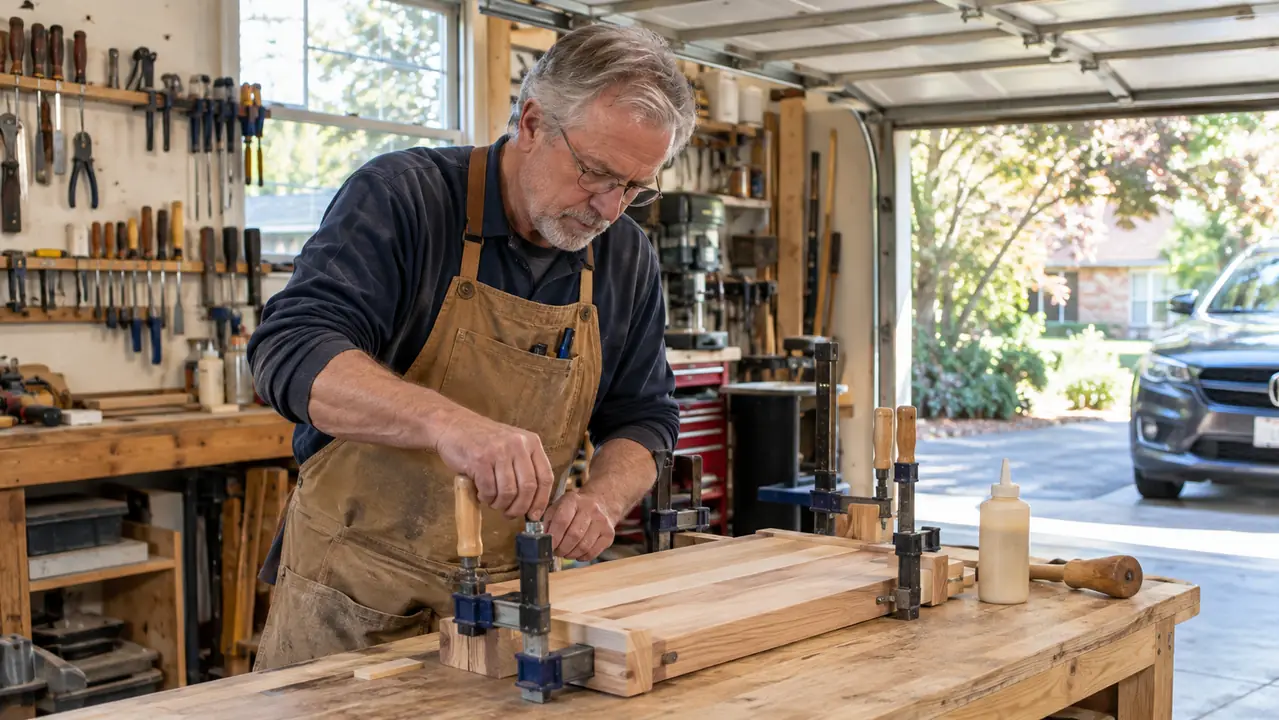
Four clamps is the wrong number. I will say that at the start, because it is the thing I wish someone had said to me before I carried the IRWIN Quick-Grip 6-inch one-handed mini bar clamp four-pack home from the store. Four sounds like a set. It is not a set. It is a start. You will get one drawer box squared and closed, reach for the fifth clamp, and discover that your fingers are already tacky with glue and the joint has begun to creep. That is not a knock on the clamp. It is a knock on the arithmetic of buying clamps in a pack of four and expecting it to cover a glue-up with eight pieces of wood in it.
I am 61 now. I retired four years ago after 34 years of finish carpentry, and I build furniture in a two-car garage shop outside Boise, Idaho, on a concrete floor with one small electric heater and winters that are cold and dry. When I rebuilt my hand tool kit in the first winter after I retired, I bought these mini clamps along with a set of Narex chisels, an IRWIN combination square and a Norton oil stone. That was three years ago. Everything below comes from using them in that shop, on drawer parts, jigs, stop blocks and small assemblies. Not from a spec sheet, and not from a single afternoon.
The Quick Verdict
The small one-handed clamp I reach for first on the work it was built for. Not a pipe clamp, and four is not a set.
Amazon Check Today's Price →Four Is a Start, Not a Set: Check Today's Price on the IRWIN Four-Pack
Six-inch one-handed bar clamps with a squeeze trigger, an instant release, soft pads and hardened steel bars. IRWIN rates them at 140 pounds of clamping force. Three years in my shop and they still come out for every drawer and every jig.
Amazon Check Today's Price on Amazon →How I've Used Them for Three Years
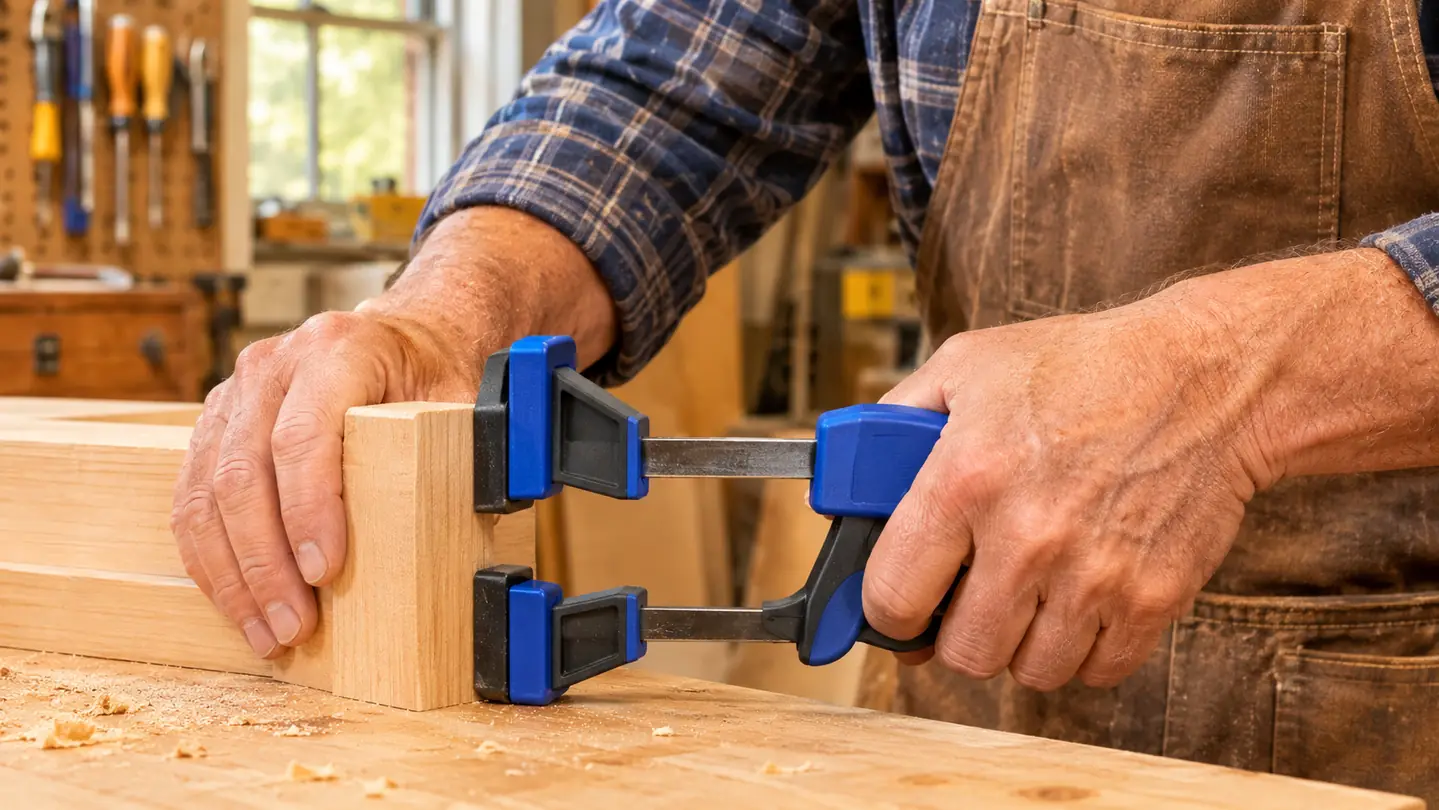
The first real job I put them on was a cherry bookcase, two winters ago. Eight drawer boxes and four clamps, so I assembled them two at a time and let each pair sit the full hour before I moved on. Titebond III gives about 8 to 10 minutes of working time, which is plenty when the clamps are already open and sitting on the bench within arm's reach. That is the whole argument for a one-handed clamp and it took me exactly one drawer box to understand it. The other hand stays on the joint. Nothing slips while you are hunting for a tool.
Before these I used old C-clamps and a set of six pipe clamps, and I still own both. A C-clamp wants two hands and a good deal of patience. You hold the parts, you set the clamp, it slides, you start over. The trigger on the IRWIN clamps changes that sequence completely. You squeeze until the pad meets the wood, squeeze again to draw the joint down, and move on to the next one. When the glue is set you pull the release and the jaw opens instantly. That matters more than it sounds when you have four of them to take off and a wet rag waiting in the other hand.
Three years on, the pads are still soft and I have not had one mark a surface I cared about. The bars are hardened steel and none of them has bent. I have never had a jaw slip while glue was going off. What I have not done is buy more of them, and that is the part of this review worth arguing with. Four has been enough for how I work, which is one small assembly at a time, in stages, with the radio on and nobody waiting on the piece but me.
What Nobody Tells You About the Four-Pack
Nobody tells you the four-pack is a starter quantity rather than a working quantity. Four clamps will close one drawer box, one small frame, one jig. They will not close a bank of drawers in a single glue-up, and if you try, you will be standing there with four clamps on eight pieces of wood and a bottle of glue going off in your hand. My advice is either to buy the four-pack and stage your assemblies around it, or to buy two four-packs and stop thinking about it. What I would not do is buy one four-pack and assume the problem is solved.
The second thing nobody tells you is which size ends up in your hand. The six-inch clamp is the one. It reaches around a drawer side, closes a face frame corner, holds a stop block while you set a fence, and does all of it without banging into the bench or the machine behind it. If these are your first one-handed clamps, buy this size first and go bigger only when a specific job asks for it. A long clamp that is awkward to place gets left in the drawer, and a clamp in a drawer clamps nothing.
The third thing is quieter. These are resin-bodied clamps with hardened steel bars, and that pairing is exactly what makes them light enough to hold in one hand all afternoon. It also means they are not the tool you throw into a job-site bucket at the end of the day. I spent 34 years throwing tools into a job-site bucket. In the garage they live on a shelf above the bench, and after three years they still look like clamps rather than survivors. Treat them like shop tools and they will last a long while. Treat them like job-site tools and you will be buying them again.
The 140-Pound Number, in Practice
IRWIN rates these at 140 pounds of clamping force. That number is honest rather than generous. On a drawer side or a jig fence, 140 pounds is more than the job needs and you will stop squeezing well before you reach it. On anything that wants to cup or bow, it is not much at all. I do not try to pull a warp out of a board with these. I joint the board flat instead, which is the correct fix and always was, and it does not depend on how strong my clamps happen to be.
Where the number does matter is repeatability. The trigger lets me squeeze to a feel I recognize, joint after joint, without a wrench and without counting turns. With a C-clamp I am always guessing whether this one is as tight as the last one. With these, my hand knows. On small assemblies that consistency is worth more than raw force, because the failure mode on a small glue-up is rarely a starved joint. It is a joint that moved while you were not looking.
Eight drawer boxes, two at a time, an hour each. Three years on, not one of those joints has opened.
You should also know what the trigger gives up. A screw clamp lets you creep up on pressure in tiny increments. A trigger gives you a squeeze, and a squeeze is coarser. On soft pine that can mean a slightly deeper pad mark than you intended, and on a thin drawer bottom it can mean more force than you meant to apply. I solve it by squeezing to contact, checking that the joint has closed, and stopping there. That is a habit rather than a defect, but it is a real difference between these and a screw clamp.
The Bars, the Pads and the Lifetime Guarantee
A bar clamp is only as good as the bar, because the bar both carries the load and keeps the moving jaw travelling straight. On these it is hardened steel and my jaws have tracked true for three years without my having to think about it. The pads are soft and they have stayed soft, which is the part I expected to go first. The pack carries the full lifetime guarantee IRWIN puts on its hand tools, and I have never had occasion to use it, which is the best thing I can say about a guarantee.
The comparison I actually make is with the C-clamps these replaced. A C-clamp of similar capacity will outlive all of us, and it will also take two hands and a certain amount of cursing every single time you pick it up. The mini clamps trade a little of that brute durability for speed and for one-handed operation. In a home shop, where nothing is on fire and I am not paying myself by the hour, speed was the thing I was short of. That trade has been worth making.
Where They Genuinely Earn Their Keep
Drawer parts are the main event. Sides to fronts, bottoms into grooves, runners on. I can hold a drawer box square with one hand, set the first clamp with the other, check the diagonals, and then let go. That check is the step people skip and it is the step that decides whether a drawer racks in two years. With C-clamps I never checked anything, because both hands were busy holding a clamp onto the work. The clamp was not the problem. The problem was that the tool demanded both hands at the exact moment I needed one free.
Jigs and fixtures are the second. A stop block on a crosscut sled, a fence on a tapering jig, a backer board under the drill press, the template I use to rout the finger recess in a cutting board. All places where a clamp needs to be small, quick and out of the way, and where 140 pounds of holding force is already more than enough. I have a stop block that has been clamped to the same sled for as long as I have owned them. It has not moved, and I have not had to think about it.
The Clamp I Pick Up First on Any Small Glue-Up
Squeeze trigger, instant release, soft pads, hardened steel bar, six inches. A shop tool rather than a job-site tool, and it does small assembly work better than anything else I have owned.
Amazon Check Today's Price on Amazon →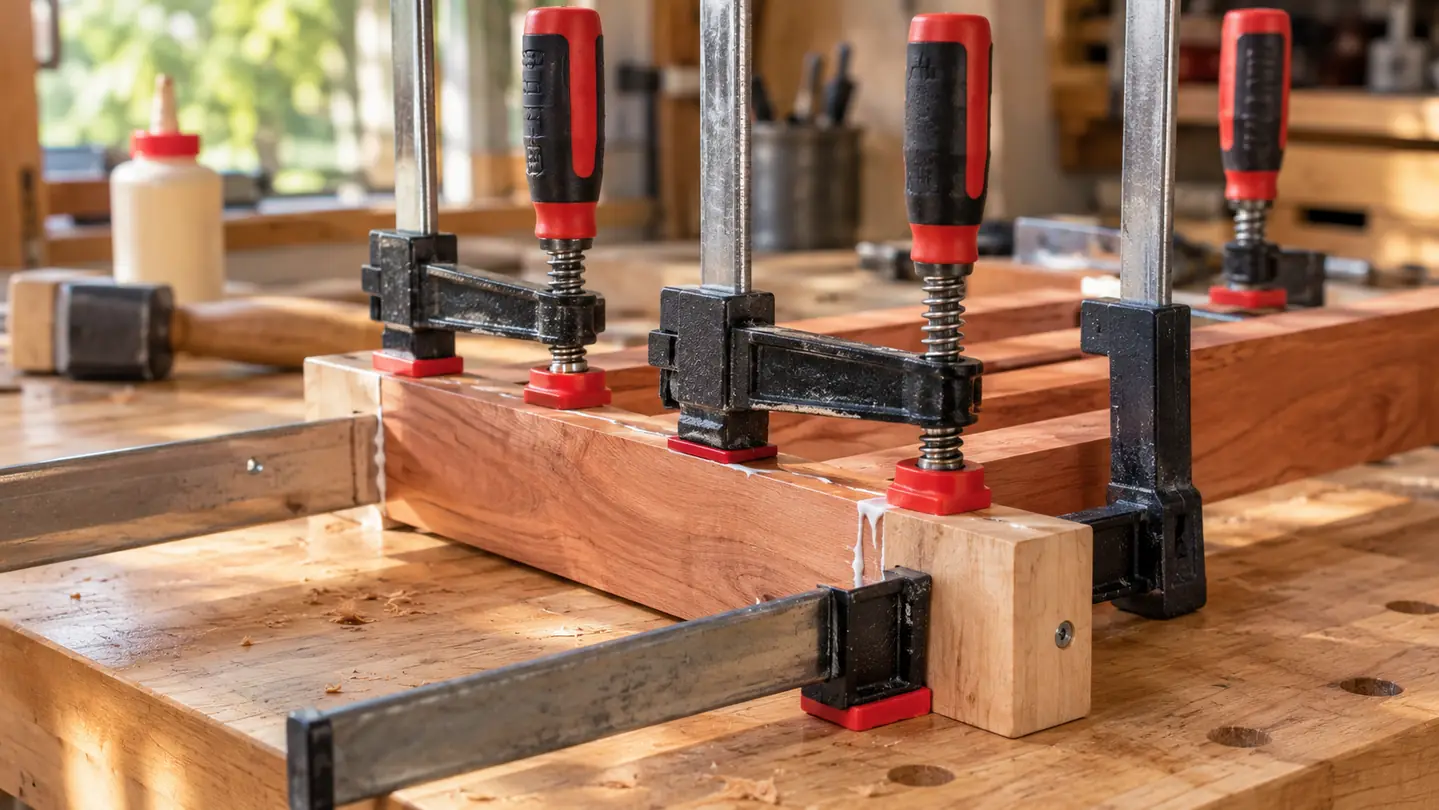
Where They Fall Short
Four clamps is the first shortfall and I have made that case already. The second is reach. Six inches is a small clamp and small is the entire point, but it means these do not go near a carcass, a face frame onto a cabinet side, or anything where the clamp has to swallow more than a handful of stock. For that work I go to the pipe clamps and accept the slower setup, because a slower setup is still faster than a joint that did not close.
The third is the one I keep coming back to. The trigger is fast, but it does not let you fine-tune. If a job needs a specific, gentle, repeatable pressure, a screw clamp is the better tool and I will not pretend otherwise just because I like these. Knowing which clamp to pick up is most of the skill in a glue-up, and no tool makes that decision for you.
What I Liked
- The trigger closes a joint one-handed, which leaves the other hand free to hold the parts
- The release opens the jaw instantly, so four clamps come off as fast as they went on
- Soft pads have not marked a finished surface in three years of use
- Hardened steel bars have stayed straight and the jaws have tracked true
- The six-inch size stays out of the way on jigs, sleds and stop blocks
- Full lifetime guarantee from IRWIN
Where It Falls Short
- Four is not enough for a full drawer bank or any multi-part glue-up
- 140 pounds of force is not enough to pull a warp out of a board
- Resin bodies are shop tools, not job-site tools, and will not take a bucket
- The trigger is coarser than a screw clamp when you need fine pressure
- Six inches of reach limits them to small work
I want to be fair about that list, because counting items makes the cons look heavier than they are. Every entry on it is a matter of scope, not quality. These clamps are not failing at anything. They are small clamps, and small clamps do small work. Judged as small one-handed clamps, which is what they are, I have not used a better one. Judged as the only clamps you own, they come up short, and they were never going to be anything else.
What They Will Not Do
They will not clamp a tabletop. I built a walnut dining table for Marit last winter and the glue-up on that top was six pipe clamps end to end, and no four-pack of anything was going to help with it. Wide panels and tabletops are pipe clamp work in my shop and they always will be. The mini clamps never touch a tabletop. If that is the work in front of you, these are not the clamps you need, and I would rather tell you that than have them sit in your drawer.
They will not hold a whole carcass while you square it, they will not stand in for a vise, and they will not do the job of a bar clamp twice their length. The honest framing, after three years, is that these are the clamps I reach for first and put down last on a small job, and the clamps I never reach for at all on a big one. That is not a flaw in the tool. It is a job description, and the tool matches it.
Who This Is For
This is for the person building drawers, small cases, jigs and fixtures in a home shop who is tired of needing three hands. It is for anyone who has held a corner closed with a knee while fumbling a C-clamp and felt the joint slide out of square. If most of what you clamp is under a foot, if you glue up in small batches, and if your shop is a garage rather than a truck, this four-pack is where I would start. I would plan on a second one before too long.
It is also for the person who wants the glue-up to be the calm part of the day. Titebond III gives about 8 to 10 minutes of working time, and I clamp for at least an hour and leave the joint alone for 24 before I put any stress on it. That is a lot of minutes to spend fighting a tool. Four clamps sitting open on the bench, within reach, with the release already broken, changes how a glue-up feels. It stops being a race.
Who Should Skip It
Skip them if your work is panels and tabletops. Skip them if you glue up more than four parts at once and cannot stage the job. Skip them if you are still on job sites and your clamps ride in a bucket, because resin bodies will not enjoy that and a steel bar clamp will. And skip the four-pack if you already know you need eight, since buying twice is a worse plan than buying once. None of that is a criticism of the clamp. It is a description of who it is for.
One more thing, and this is the part that does not sell clamps. If you have been getting by with C-clamps and pipe clamps and your joints are coming out square, you do not need these. They will save you time and temper on small assemblies, and that is the whole of what they will do. Tools do not fix technique. At best they stop getting in the way of it, and a one-handed clamp gets out of the way better than anything else I have used in 34 years at this trade.
Small Clamps, Small Work, Done Right: Check Today's Price on the IRWIN Four-Pack
Four six-inch one-handed clamps, 140 pounds of force, an instant release and a full lifetime guarantee. Three years in a home shop and they are still the first clamps I pick up.
Amazon Check Today's Price on Amazon →