

Traditional bar clamps and the IRWIN Quick-Grip mini clamps are not the same tool, and I do not reach for them for the same job. I spent 34 years as a finish carpenter, retired four years ago, and I have built furniture in my two-car garage shop outside Boise for 20 years. The IRWIN Quick-Grip 6-inch one-handed mini bar clamps came into my shop in the first winter after I retired, three years ago. I bought one four-pack. I still own exactly four. The traditional bar clamps in my shop are the six pipe clamps I have had for years, plus a few old C-clamps that are not bar clamps but do some of the same holding. If you are trying to decide between a small one-handed clamp and a long bar clamp, the short answer is that the mini clamps win on small assemblies and the traditional bar clamps win on wide panels. That is the whole comparison in one sentence. The rest is where the line falls in a real shop.
Where people get into trouble is buying one kind and expecting it to do the other kind's work. A 6-inch mini bar clamp is not going to pull a walnut tabletop together. A long pipe clamp is not the thing I want inside a drawer box or holding a stop block while I set up a cut. I use both, and I keep them in different places for that reason. The IRWIN clamps hang on a peg within arm's reach of the bench, about chest height and a little to the left of the vise, so I can grab two without looking away from the saw. The pipe clamps live on the wall rack behind the bench, handles up, because they are long and awkward and I do not need them on every project. That peg and that rack are most of the argument, honestly. The tool I can reach without thinking is the tool I actually use. If you are newer to the craft, that split is the thing to understand before you buy anything: decide where each clamp will live in your shop, and the buying decision gets a good deal simpler.
| IRWIN Quick-Grip Mini Bar Clamps | Traditional Bar Clamps | |
|---|---|---|
| One-handed operation | Trigger squeeze tightens and releases with one hand while the other hand holds the parts | Usually two hands, one on the bar and one on the screw handle |
| Clamping force | Rated to 140 pounds, enough for small glue-ups | Screw and pipe clamps can apply more force for wide panels |
| Reach | 6-inch bars, best on drawer parts and small assemblies | Long bars reach across tabletops and bookcase sides |
| Confined areas | Small body fits inside a drawer box or a jig | Long bars and handles need room to swing |
| Speed on repeated small parts | Trigger action is fast when you are clamping many small pieces | Threading a screw handle takes longer on the same pieces |
| Wide panel glue-ups | Not the tool for a tabletop; the bars are too short | The right tool for a tabletop or a wide panel |
| Durability under shop abuse | Hardened steel bars and a full lifetime guarantee, but the resin body can be chipped if dropped | Steel bar clamps take drops and keep working |
| Storage and handling | Light and small, hangs on a peg by the bench | Long bars take wall space and are awkward to move |
| Best for | Small assemblies, drawer parts, jigs, stop blocks | Wide panels, tabletops, heavy glue-ups |
Where IRWIN Quick-Grip Wins
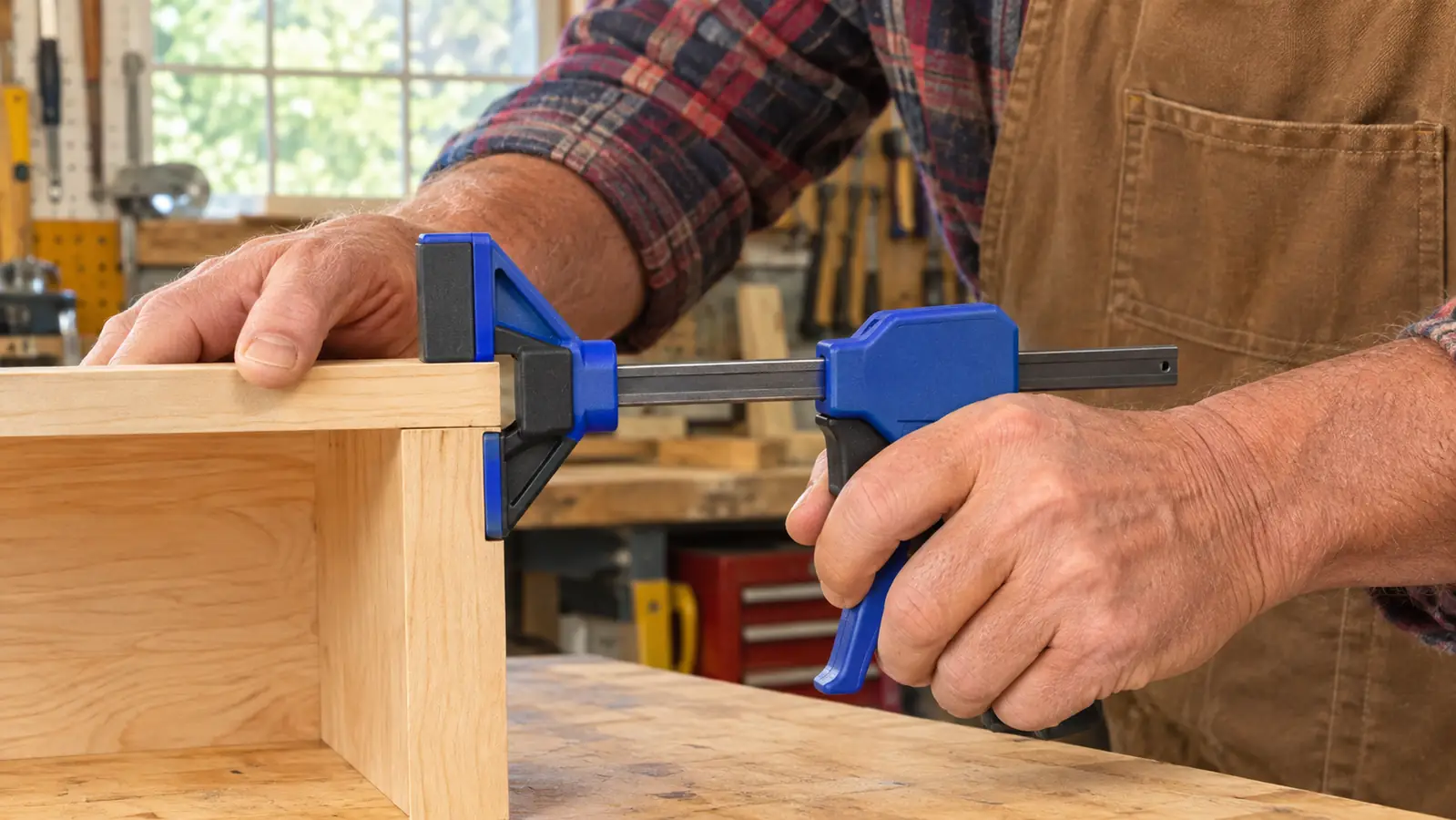
Small assemblies are where the IRWIN Quick-Grip clamps earn their place. When I built the shaker-style end tables this year, the drawer parts and the apron pieces needed to be held square while the glue set. The aprons are 3/4-inch stock, ripped to a little under 4 inches wide, and an apron-to-leg joint wants to slide on you the second you look away. The one-handed trigger lets me squeeze the clamp closed with one hand while the other hand keeps the parts aligned against the square. That sounds small until you are working alone, which I almost always am. With a traditional bar clamp, I usually need one hand on the bar and one hand on the screw handle, and the workpiece wants to slide while I do it. The mini clamps tighten fast and release fast, and the hardened steel bars do not flex under the force I put on a small joint. All four came out of the pack for one apron assembly and I still had room to work. They are light enough to move around the bench without thinking about it.
The other place they win is confined space. A drawer box, a small cabinet carcass, a jig, a stop block clamped to the table saw fence, those are all places where a long bar clamp is in the way. The IRWIN mini clamps have a small body and a 6-inch bar, so they fit inside the work instead of hanging out into the aisle. A good example is a drilling jig I made for the end tables this year. It is a scrap of 3/4-inch plywood with a fence screwed to one edge, and I clamp it to the drill press table with two of the mini clamps, one on each side. The clamps sit below the table surface and never come near the bit. Set the fence with my IRWIN combination square, lock it, drill the row of holes, then release both clamps with a squeeze and the jig lifts off in a couple of seconds. With a pipe clamp I would be threading a screw handle underneath the table where I cannot see it. The 140 pounds of clamping force is more than enough for the small glue-ups I do. I am not trying to pull a warped board straight with them. I am trying to hold two prepared parts together while the glue does its job. For that, the trigger action and the small size are the whole reason I reach for them. They are also the clamps I hand to someone who is learning, because the one-handed action is easier to control than a screw handle and you can feel the pads touch the wood.
The trigger action also helps with glue-up timing. Titebond III gives me about 8 to 10 minutes of working time, and I clamp for at least an hour. On a small assembly, I do not want to spend half of that working time fiddling with a screw handle. I want to get the parts aligned, squeeze the clamps closed, and check for square. So I set the four clamps out on the bench before I open the bottle, triggers facing me, pads where I can see them. Spread the glue with a small brush, fit the parts, and the first clamp goes on in a couple of seconds. The IRWIN clamps let me do that with one hand while I hold the square with the other. That is not a small thing when you are working alone in a cold garage. In winter I keep the glue bottle indoors and warm the shop before I start, because Titebond III does not like temperatures below 47 degrees. On a January morning the small electric heater runs a good while before I will open the bottle at all, and I leave the clamps on the bench near it so the steel is not cold enough to chill a joint. The clamps are the least of my worries at that point.
Where Traditional Bar Clamps Win
Traditional bar clamps win on reach and force, and there is no way around that. The walnut dining table I built for Marit last winter had a top made from five boards glued edge to edge, each one a little over 6 inches wide, so the finished top came out near 30 inches across. That is a wide panel, and it needed long clamps across the width with enough force to bring the joints tight. I laid the boards out dry first and checked the grain direction, then numbered the edges in pencil so I could not get the order wrong once the glue was open. I glued it in two stages because I did not want a pile of squeeze-out setting up while I worked. My six pipe clamps did that work, three from the top and three from the bottom, with scrap oak cauls waxed so they would not stick to the walnut. The IRWIN mini clamps never touched that tabletop, and they should not have. A 6-inch bar cannot span a tabletop, and the clamp is not built to pull a wide panel together. The same is true for the cherry bookcase I built two winters ago. The case sides and the shelves needed clamps with reach. The mini clamps were useful for the small face frames and the drawer parts, but the main carcase went together with the pipe clamps.
The old steel bar clamps also take abuse in a way the mini clamps do not. The IRWIN clamps have resin bodies and hardened steel bars, and they are rated for 140 pounds. They are not a heavy steel bar clamp, and I do not treat them like one. If I drop a pipe clamp on the concrete, I pick it up and keep going. If I drop a mini clamp, I look it over and check the pads. That is not a knock on the tool. It is a matter of matching the tool to the work. The traditional bar clamps are simple, heavy, and repairable. They can sit on a glue-up for an hour and not care. They can hold a panel flat while I crawl underneath with a straightedge to check for twist. They are slower to set and they take two hands, but on a big panel they are the right tool. I would not want to build a tabletop without them.
Long clamps also let me work across a panel in a way the mini clamps cannot. When I glue up a tabletop, I put a clamp every few inches along the width, and I alternate them over and under the panel to keep it flat. That takes reach. The mini clamps are not part of that process. I use them on the small parts that go with the table, like the drawer runners or a jig for the corner blocks. The big work stays with the pipe clamps. That is not a compromise. It is the way the shop is set up. If I tried to do the tabletop with mini clamps, I would be short on reach and short on force, and I would waste good lumber.
The Small Clamps for the Small Work
The IRWIN Quick-Grip 6-inch mini bar clamps are the ones I keep by the bench for drawer parts, jigs, and stop blocks. If that is the work in front of you, this is the four-pack I own.
Amazon See the IRWIN Quick-Grip Clamps on Amazon →
Who Should Buy Which
If most of your work is small assemblies, drawer parts, face frames, jigs, and holding a stop block, the IRWIN Quick-Grip mini clamps are the better first buy. They are fast, they work one-handed, and they fit where a long bar will not. A four-pack is enough to get started on the kind of furniture I build at home, and four is about right for one small glue-up at a time, which is how most of us work anyway. I would not buy them expecting them to replace a set of bar clamps. I would buy them because they do a different job well. If you are building shaker-style end tables or cutting boards, they will earn their keep. If you are building a tabletop, they will not.
If your work is wide panels, tabletops, bookcase sides, or any glue-up that needs reach and force, traditional bar clamps are the better first buy. You need enough of them to span the panel, and on a tabletop that means one every few inches along the width, which adds up faster than you expect. You also need the patience to set them with two hands. The mini clamps are a good addition later, when you get tired of using a long clamp on a small part. That is the order I would recommend for a home shop: long clamps for the big work, then a four-pack of mini clamps for the small work. I did it the other way around because I bought the mini clamps first, but I already owned the pipe clamps. If I were starting from nothing, I would buy the long clamps first.
A beginner might ask why not just buy a lot of one kind. The answer is that you will end up fighting the tool. If you only own mini clamps, you will try to glue up a panel and come up short, and then you will get creative with a strip of scrap and more clamp pressure than the joint wanted, and the panel will bow. If you only own long bar clamps, you will curse them every time you need to hold a drawer part, and pretty soon you will start skipping the square check because setting the clamp takes too long. The IRWIN four-pack is small enough to keep on the bench, and the pipe clamps are long enough to keep on the wall. That is the split that works in my shop. It will work in yours if your projects look anything like mine. Buy for the next three projects on your list, not for the projects someone else builds.
Keep the Long Bars for the Tabletop and the Mini Clamps for the Drawer
If you are setting up a home shop, buy the clamps that match the work you actually do. The IRWIN Quick-Grip four-pack is the one I keep within arm's reach.
Amazon Check the IRWIN Quick-Grip Clamps on Amazon →