

Six-inch clamps do more work in my shop than any other clamp I own, and for the past three years the ones I reach for first have been the IRWIN Quick-Grip one-handed mini bar clamps in the four-pack. I bought them the winter after I retired, in the same month I bought a new combination square and a set of chisels, because I was done using beat-up job-site tools in my own garage. Thirty-four years of trim and cabinet work teaches you what a clamp has to do to a joint, and it also teaches you which clamps you leave in the truck at the end of the day.
Mine have been on every piece of furniture I have built since. The cherry bookcase two winters ago. The walnut dining table for Marit last winter. The shaker-style end tables I am finishing now, and the cutting boards that go out as Christmas gifts every year, though those wide glue-ups belong to the pipe clamps and always will. I am not going to tell you a four-pack of small clamps is all you need, because it is not. What I can tell you is what these four do well, where they quit on you, and how they have held up after three years of glue, sawdust and cold mornings in an unheated garage.
The Quick Verdict
Four small one-handed clamps that have done three years of drawer parts, jig fences and end table glue-ups without a single failure. They will not replace pipe clamps on anything wide, and they are not supposed to.
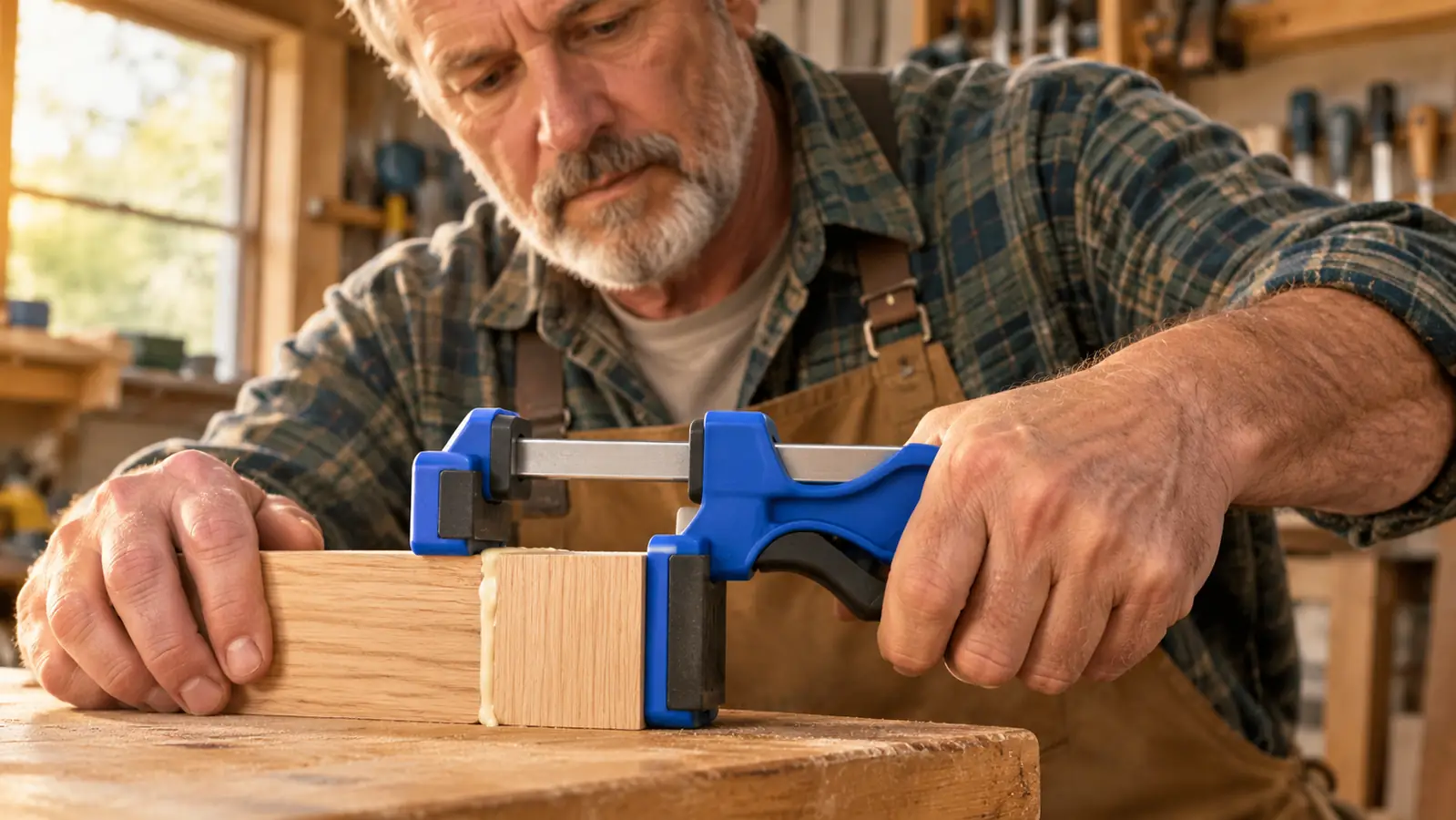
Amazon Check Today's Price →Set the joint with one hand and tighten the clamp with the other
The 6-inch opening covers drawer parts, jig fences and small assemblies. A four-pack is enough to close a glue-up and hold it square while the glue sets.
Amazon Check Today's Price on Amazon →How I've Used It
The winter after I retired I decided I was finished dragging job-site tools into my own shop. The chisels, the IRWIN combination square, the oil stone and these clamps all came in the same month, three years ago. In that time the four clamps have not broken, have not slipped on a joint I had set square, and have not lost enough grip that I have thought about replacing them.
Where they earn their keep is small work. Drawer parts and face frames. Jig pieces, when I am building a template and need a fence held square to a base. A stop block held against the rip fence so I can cut a batch of rails to the same length without measuring every one of them. Small assemblies on the end tables, where the apron meets the leg and there is no room to swing a pipe clamp around the corner.
A typical glue-up with them goes like this. I dry fit, check the diagonals, take it apart, run a thin bead of Titebond III in the mortise, and put it back together. Then I set a clamp, squeeze the trigger with the heel of my hand, and move to the next corner. One hand per clamp means the other hand stays on the joint instead of chasing a bar that wants to tip over. With a pipe clamp I need both hands and a moment of faith that nothing shifts before the pressure comes on.
An early project after I hung them on the bench was a set of drawer boxes, and the difference from the old C-clamps was immediate. A C-clamp on a drawer side wants to walk as you tighten it. These sit where you put them, and the pad lands flat.
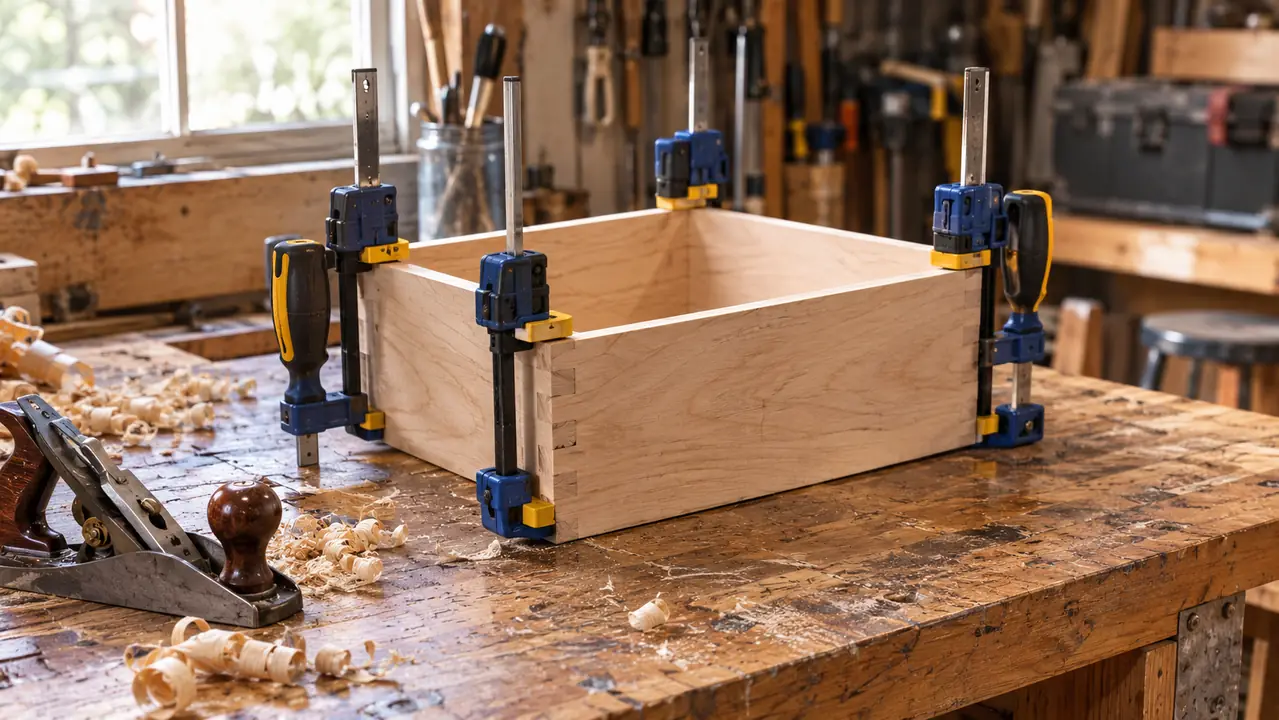
When I built the cherry bookcase two winters ago, the four clamps did the whole face frame in two passes. I glued one stile to the rails, clamped the two joints, waited an hour, then did the other side. It is not the fastest way to build a face frame and I know it. What it is, is square. I checked the diagonals with the IRWIN combination square after every pass, and the frame came out within a sixteenth of an inch corner to corner, which is as good as I need for a bookcase that lives against a wall. Trying that same frame with the six pipe clamps would have taken three times the bench space and left me with clamp heads where I needed to put my hands.
What the Trigger and the Bar Actually Do
The mechanism is simple, which is why it works. The trigger pulls the bar through the body one notch at a time. Short strokes for fine adjustment, long strokes when the jaws are wide open and you want to close the gap fast. The last two or three squeezes are where you feel the pads come down and the joint close. A second trigger releases the clamp, and it opens instantly, which matters when the glue is going off and you have set something a hair out of square.
The body is resin and the bar is hardened steel. That pairing is why the clamp is light enough to hold in one hand and still stiff enough not to bow when you put pressure on it. IRWIN rates the set at 140 pounds of clamping force. That is plenty for a drawer box, a face frame or a picture frame, and nowhere near what you would want across a tabletop.
The trigger takes a full-hand squeeze rather than a fingertip pinch, and at 61 with a lot of grip-heavy years behind me that matters more than it used to. I can close a joint with the heel of my palm and do it forty times in an evening without my forearm complaining. I have owned clamps where the squeeze lands on two fingers and the edge of the tool digs into the web of your thumb. You feel that around the third assembly and you start avoiding the clamp, which is no good for anybody.
The pads do more than people give them credit for. Soft pads on both jaws mean I can clamp a piece that has already been planed without a scrap block and without a dent. I still use cauls on softer stock when I am really leaning on the trigger, but on cherry and walnut the pads are enough on their own, and that saves me a step on every joint.
Three Years of Glue, Sawdust and Cold Mornings
Three years in an unheated garage outside Boise is a fair test for anything with steel in it. The triggers have stayed crisp. The bars have not bent, and there were one or two evenings when a joint was fighting me and I leaned on them harder than I should have.
Winter is the real test. The garage is unheated apart from one small electric heater, and in January the concrete is cold enough that I wear a flannel under my apron and still work in gloves for the first hour. I keep the Titebond III indoors and only bring the bottle out once the shop has warmed, because it will not cure below 47 degrees. The clamps do not care about any of that. Cold steel and cold resin hold a joint the same way in February that they do in July. What changes is me. My hands are slower in the cold, and a clamp that takes one hand instead of two is worth more to me in January than it is in June.
What has aged is the pads. They collect glue. A bit of squeeze-out that I miss will dry on a pad and leave a bump that prints itself onto the next piece I clamp. I check them before every glue-up now and pick the dried glue off with a chisel I keep dull for the job. The bars pick up a little surface rust if I leave them on the bench through a damp spell, and a wipe with an oily rag takes care of it.
The other thing that has aged is how I use them. When they were new I reached for them for everything, then got annoyed when they ran out of reach on a wide panel. Now they live on the bench where the small work happens and the pipe clamps live on the wall. Both sets get used on nearly every project, which is more than I can say for the old C-clamps they replaced.
IRWIN backs its hand tools with a full lifetime guarantee, and I have never had a reason to test it. If one of the four ever stops holding, that is the route I will take, but three years in the question has not come up.
Four small clamps have closed every drawer box, jig and end table apron in this shop for three years. The tabletop still goes to the pipe clamps, and that is the point.
What I Liked
- One hand to place and tighten, so the other hand stays on the joint
- Soft pads hold planed and finished stock without a scrap block
- Hardened steel bars stay stiff at 140 pounds of clamping force
- Release trigger opens the jaw instantly when a glue-up goes wrong
- Three years of shop use on the four I own with no failures
Where It Falls Short
- The 6-inch opening and short reach run out fast on wide panels
- 140 pounds is easy to overshoot on pine and cedar, and it will dent
- They do not reverse into a spreader, so they are clamps only
- Four is not many once you glue up more than one assembly at a time
- Pads collect squeeze-out and have to be picked clean before each glue-up
The Tradeoffs I've Learned to Live With
The 6-inch figure is the opening, not the reach. The distance from the bar back to the pad is short, which is fine for the thickness of a drawer side and useless for anything with height to it. If a joint sits well up from the bench, these will not get there, and no amount of squeezing changes that. It is not a defect, it is the size of the tool, and knowing it ahead of time saves you a frustrating afternoon.
The place it caught me was the leg-to-apron joint on the shaker end tables. The apron sits between the legs and the joint is low, so reach was not the problem. The problem was the leg standing in the way of the bar. On the inside corners all four clamps went in clean. On the outside corners the bar had to come in past the leg and only two of the four would sit flat. I swapped the other two for pipe clamps with the glue already open and the working time ticking, which is not a thing I want to do twice in one evening.
You can also crush an edge with them. The pads are soft and 140 pounds is easy to overshoot on pine or cedar. I stop squeezing when the glue line just starts to show a bead and no further. On a softwood drawer side, a few extra clicks of the trigger will leave a dent you will be planing out later, and the clamp will get the blame for it.
The last thing is the count. Four is the right number to keep in a drawer and the wrong number for a bigger assembly. When I glue up four end table aprons in one go I want eight of them, and I make up the difference with pipe clamps, which does not spread the pressure evenly. A second four-pack has been on my list for a while and I have not gotten to it yet.
How They Compare to the Pipe Clamps I Still Own
I still own six pipe clamps and they are not going anywhere. A pipe clamp is for a tabletop, a wide panel, a bookcase carcass, anything that needs reach. You thread the length of pipe you need onto the head and the tail and pull a glue-up closed across a span no small clamp will ever cover. The trade is weight and speed. It takes two hands and a few seconds of fiddling to get one seated where you want it.
The mini clamps are the opposite trade. Short reach, light, fast, one hand. Between the two sets I have not found a joint I cannot clamp. Before these, I used the pipe clamps and a handful of old C-clamps for everything, including the small work, and the small work suffered for it. C-clamps on a drawer box slip, dent the stock and take three hands to place.
People ask which set to buy first, and the honest answer depends on what you build. If you are making cabinets and tables, the pipe clamps come first, because nothing else will pull a carcass square. If you are making boxes, drawers and small frames, the small clamps come first, because the pipe clamps are miserable at that scale. I would buy them in that order again.
Who This Is For
This is for someone building small assemblies who is tired of fighting a clamp that needs two hands and a third one to hold the joint. Drawer boxes, face frames, picture frames, jigs, template fences, small boxes, anything where the pieces are light and the joint is close to the bench. It is also a sensible first clamp purchase if you are setting up a bench from nothing, because a four-pack covers more of your early work than a pair of long bar clamps will. A newer woodworker with a contractor saw and a homemade bench will find a use for all four on the very first project.
Who Should Skip It
If your work is mostly panels, tabletops and cutting board glue-ups, buy pipe clamps first. Four 6-inch clamps will not span the width of a cutting board, and using them anyway gives you a joint that is tight in the middle and open at the ends. Skip them too if you want one clamp that does everything, because this is not that clamp and the reach limit will frustrate you on the first wide panel. And if you need a spreader, look elsewhere. These clamp, and that is all they do.
The four clamps that stay on the bench instead of on the wall
Three years of drawer parts, jigs and small glue-ups, and the four I bought are still the four I use. If your work is small and your hands are busy, this is the size to start with.
Amazon Check Today's Price on Amazon →