
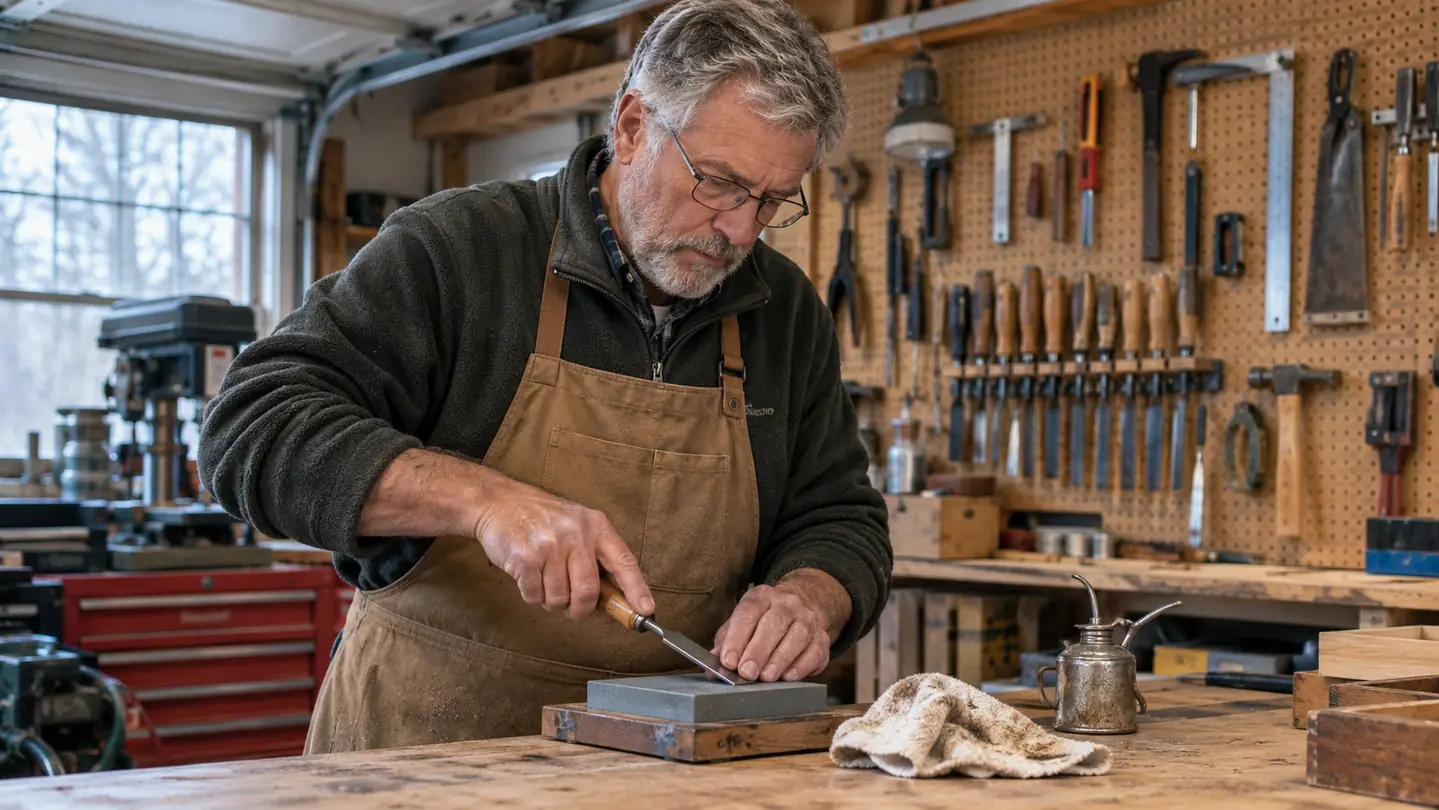
Three years ago, in the first winter after I retired, I bought the Norton combination oil stone. It came in the same order as a set of bench chisels, a combination square and a pack of small clamps, because I had decided that the beat up tools I had dragged around job sites for 34 years were not coming into my home shop. The stone was the plainest thing in that box. It is also the one I have the most opinions about. What follows is the honest version of what to expect, including the parts of owning an oil stone that the product listing leaves out.
Start with the thing almost every review skips. A new oil stone is not ready to use. Mine was not flat, it was bone dry, and the first session I spent with it was not sharpening. It was flattening the stone itself on a sheet of wet or dry paper laid over a plate of glass, which is what I had used at home before I bought anything better. That is not a fault of the Norton stone. It is how these stones come off the line, and I have not met a new one that did not want the same treatment. But the listing does not say it, and the cheerful reviews written on day one usually do not either.
The Quick Verdict
A flat, oiled Norton stone sharpens a chisel or a plane iron well and keeps doing it for years. Budget an hour of prep before the first edge, and understand that the coarse side does more of the real work than the fine side does.
Amazon Check Today's Price →The stone that lives on my bench, not the one I wish I had bought instead
8 by 2 by 1 inches, corundum, with a 100 grit side for damaged edges and a fine side for honing. Current price and the full listing are on Amazon.
Amazon Check Today's Price on Amazon →What Nobody Tells You Before the First Use
Three things surprised me before the first project was done, and none of them had anything to do with steel. The first is flatness. A bench stone has to be flat, or it will put a belly in a chisel back that you will chase for an hour and never quite catch. Mine needed work out of the box, and I check it once in a while since, with a straightedge and a pencil line across the face, because a stone wears in the middle where the blade runs. A hollow stone sharpens a rounded edge. If you do one maintenance chore on this tool, do that one.
I did my flattening on a Saturday morning in February, at the kitchen table rather than in the shop, because the shop runs cold and wet paper needs to stay wet. A sheet of 220 grit wet or dry paper on a plate of glass, plenty of water, a pencil scribble across the whole face of the stone, and long strokes until the pencil came off even from end to end. It took four sheets and most of an hour. The first sheet clogged inside ten minutes because I had been stingy with the water. If you do this yourself, flood the paper, change it the moment it stops cutting, and check with a straightedge every few minutes instead of only at the end. What you are looking for is no daylight under the middle of the rule and no rock when you set the stone down on a flat surface. When mine finally sat still without rocking under my thumb, it was ready. Not before that.
The second is oil. This is an oil stone and it stays an oil stone. A few drops of light honing oil spread across the face, never water. Water on an oil stone is the beginning of a bad afternoon. The oil floats the swarf and keeps the pores from loading up with steel. It also gets on your hands, and then on everything you touch afterwards, which is worth knowing before you reach for a finished panel.
The third is what does not come with it. You get the stone. That is the whole of it. No base, no lid, no case, no angle guide, no oil. If you have never honed with a guide, add one to the order, because freehand honing at a steady angle is a skill that takes years and I still do not trust my own hands to hold a 25 degree bevel for a dozen strokes. I use a simple side clamp guide set to hone at 30 degrees. The stone itself is 8 inches long, 2 inches wide and 1 inch thick, and it weighs a pound and a half, which is heavy enough to sit still on the bench and light enough to move out of the way when you need the space back.
How I Use It on Chisels and Plane Irons
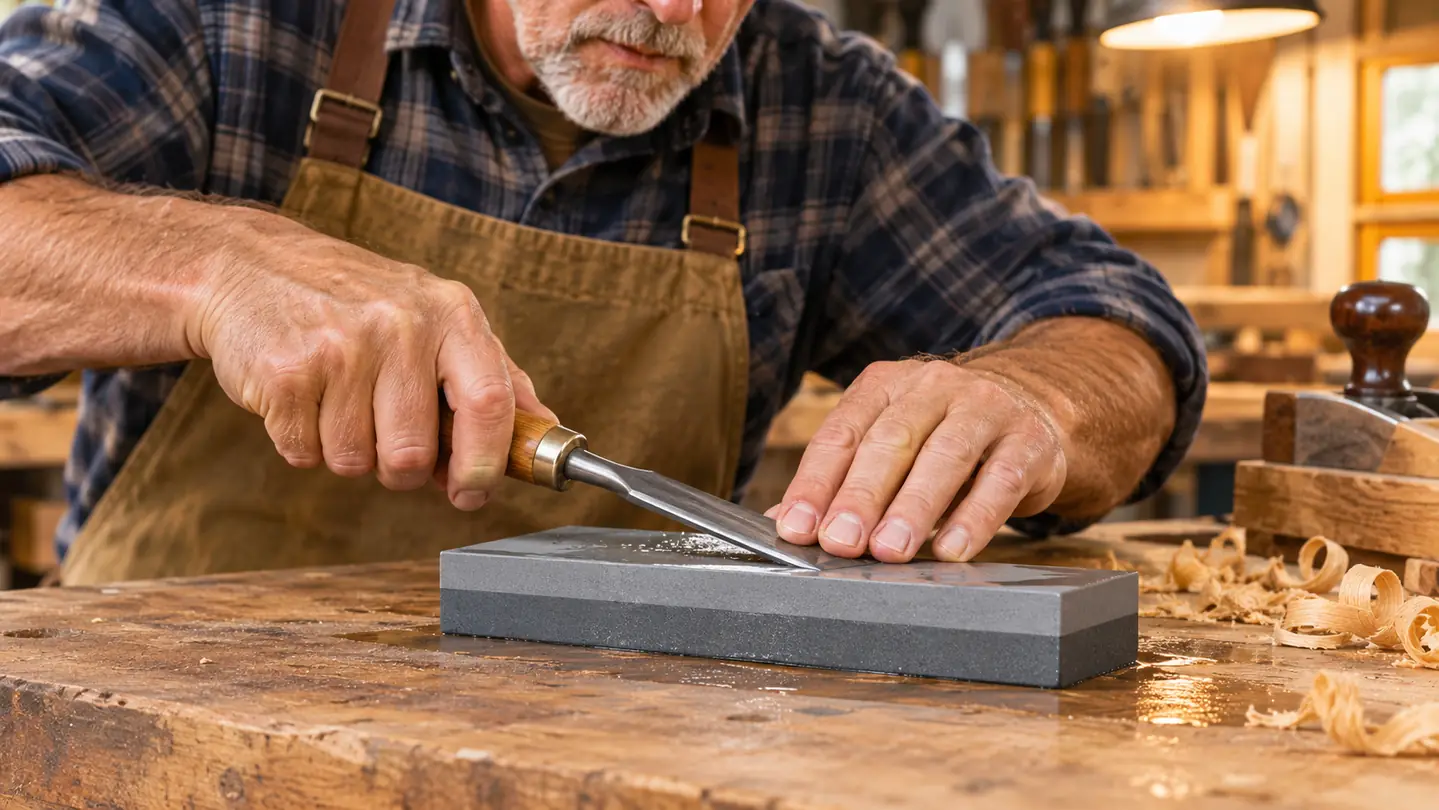
The stone sharpens my chisels and my plane irons. That is its job here and it does it. My chisels came ground at 25 degrees and I have kept them there. The stone hones at 30 degrees, which puts a small secondary bevel at the edge and makes it much quicker to bring an edge back. Coarse side first if the edge is damaged or if I am re-establishing a bevel, fine side to finish, then a leather strop to take off the burr and polish. Three years in, that sequence has not changed and I have not found a reason for it to.
Mine stays with the woodworking tools. I keep one stone, one job, one place on the bench. That is a preference, not a rule.
The coarse side is 100 grit and it earns its keep. I chipped the edge of my widest chisel on the corner of the benchtop planer two winters ago, in the middle of the cherry bookcase, and I did not want to send it out or replace it. Twenty minutes on the coarse side took the chip back to good steel and the fine side brought the edge back after that. It is a repair stone, not a grinding stone for reshaping a badly out of square chisel, and knowing which of those jobs you are asking of it matters.
The plane irons get the same treatment, and they are the reason the stone stays out on the bench instead of going into a drawer. Last winter, while I was building the walnut dining table for Marit, I spent the better part of a week jointing and smoothing walnut, and I touched up the iron every evening. Four or five strokes on the fine side, a few passes on the strop, back to the bench. Five minutes at the end of the day, and the next morning the iron was cutting again instead of skating. Let an iron go a full week without attention and you will spend the first hour of the following Saturday on the coarse side instead of on the table. That arithmetic is the whole reason I keep the stone where I can reach it without moving anything.
Two technique notes, since I have made both mistakes. Work the whole length of the stone, not the middle few inches, or you dish it and then you are flattening again sooner than you wanted. And keep the pressure light on the fine side. The fine side is where the edge is finished, and leaning on it does not make anything sharper, it just works the stone harder and wears it faster. Let the stone cut.
Twenty minutes on the 100 grit side took a chipped chisel edge back to good steel. That is the whole argument for keeping this stone on the bench.
Three Years On, What Has Held Up
Three years of furniture work is not an industrial workload, but it is not nothing. In that time I have built a cherry bookcase, a walnut dining table for my wife, a set of shaker style end tables, and a cutting board or two every Christmas. Every one of those projects went through this stone at some point, usually more than once, because a chisel that has been struck through a mortise needs attention again before the next joint. The stone has held up. It has worn, as any stone wears, and it has wanted flattening more often than a harder abrasive would, but it has not cracked, crumbled at the corners or gone soft in the middle.
What has surprised me is how little the fine side has changed in character. It still cuts, it still leaves an edge that will pare end grain on cherry without tearing it, and it still does it in about the same number of strokes it took on the first project. A cheap stone glazes over and starts skating. This one has stayed open because I keep it oiled and I do not let the swarf dry on it. Leave yours dirty for a month and you will have a different tool on your hands, and that will be your doing, not Norton's.
Once a season I take the stone over to the bench and check it properly. Straightedge across the face, hold it up against the window light, look for daylight under the middle. Twice in three years it has shown enough hollow to be worth ten minutes on the paper, and both times it came after a run of projects where I had been lazy and worked the middle of the stone instead of the full length. Every other check it has been flat enough to leave alone. The corners are still square, the edges have not spalled, and there is no crack anywhere in it. I have watched hardware store stones go chalky and start shedding grit after a year of the same work. This one has not done that, and I put it down to oiling it every time and never letting it sit dirty overnight.
Where It Falls Short
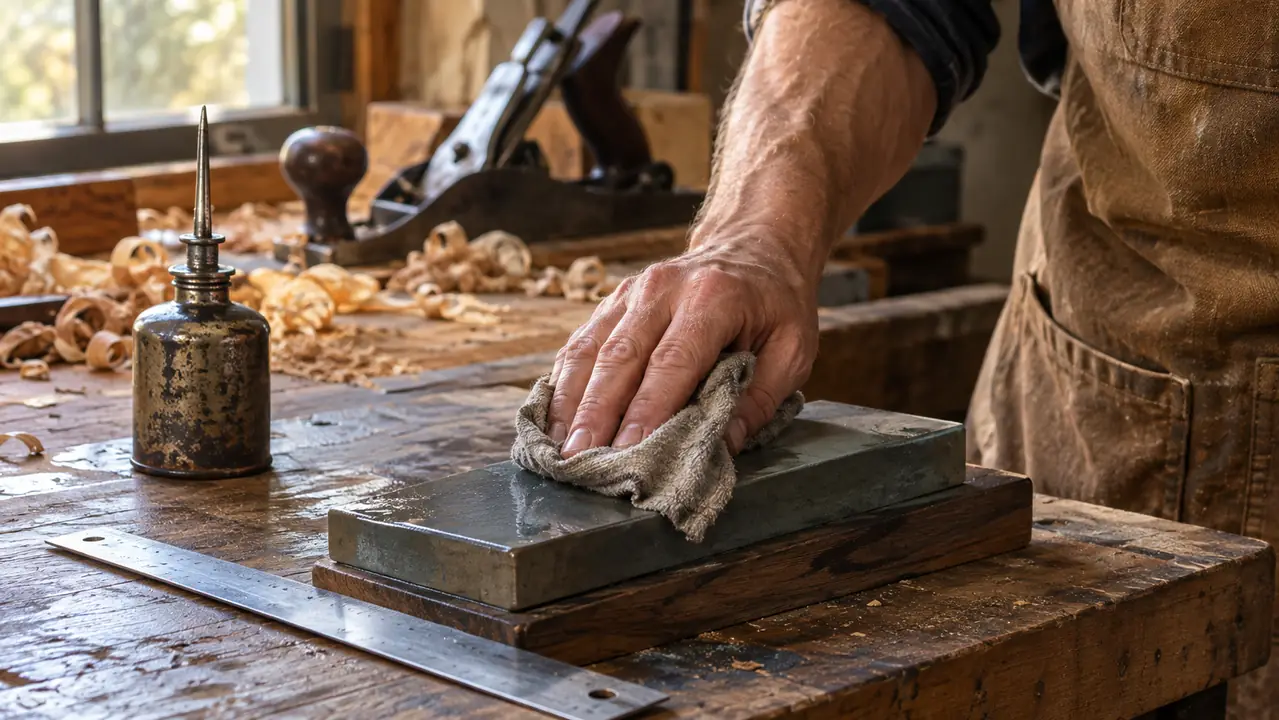
There are real drawbacks, and I would rather you hear them now than find them out later. The first is mess. Oil stones are wet, oily and unpleasant to clean up. The oil carries fine steel and stone slurry, and it finds the bench, the workpiece if you are careless, and any raw wood within reach. I keep a dedicated rag and a scrap of plywood under the stone, and I do not sharpen anywhere near a project that has already been finished. A water stone brings its own problems, but it does not leave an oil film across your bench.
I had that lesson handed to me two winters ago, during the cherry bookcase. I had been honing a chisel, and I set the oily rag down on a shelf that was already planed and sanded and waiting on finish. Ten minutes later there was a dark patch the size of a playing card where the oil had soaked in. I planed it back and sanded that shelf again from 120 grit up, which cost me most of an afternoon and a good deal of patience. Now the rag lives in a shallow plastic tray, the tray lives at the far end of the bench away from the work, and I wash my hands before I touch anything that is going to take a finish. It is a small habit. It is a lot cheaper than redoing a shelf.
The second is speed. A diamond plate cuts faster and stays flat, and I know that because I have used them at a woodworking class. If your only goal is to get a chisel back to work in the shortest possible time, a diamond plate wins and I will not pretend otherwise. What the stone gives you instead is a finer, more controlled edge at the finish and a face that does not scrape the life out of a blade. I use the stone because I like the edge it leaves. A man sharpening eight hours a day would probably keep both.
The third is that the fine side is a working edge, not a mirror. It will give you a chisel that pares cherry end grain cleanly and a plane iron that takes a shaving you can read through. It will not give you the polished bevel you see in close up photographs. I finish on a leather strop and I would not want to skip that step, so plan on one more piece of kit than you thought.
The fourth is that it dishes. Every stone does. Plan on flattening it a few times a year if you use it regularly, and checking it more often than that. And the fifth is that it has no home. It arrives as a bare stone, so storage is on you. Mine sits in a shallow plastic tray with the rag, which keeps the oil off the bench and keeps the stone from walking around the shop. It is a small thing that nobody mentions and everybody solves on their own.
What I Liked
- 100 grit side cuts fast enough to repair a chipped edge at the bench
- Fine side leaves an edge that pares cherry end grain without tearing it
- 8 by 2 by 1 inches and 1.5 pounds, heavy enough to stay put, small enough for a drawer
- Corundum stone has not cracked, crumbled or gone soft in three years of furniture work
- Simple to maintain: oil it, wipe it, flatten it once in a while
Where It Falls Short
- Arrives needing flattening and a first oiling before it does good work
- No base, no case, no angle guide and no oil in the box
- Oil makes a mess and has to be kept away from finished wood
- Slower than a diamond plate, and it dishes with use
- The fine side is a working edge, not a polished bevel
Who This Is For
This stone is for someone who sharpens at a bench, a few times a week, and wants one stone that will repair a damaged edge and finish a good one without a drawer full of grits. It suits chisels and plane irons. It suits a home shop where the stone is not asked to do production work. It suits a person who does not mind ten minutes of maintenance a few times a year and would rather own a simple, traditional setup than a rack of equipment. If that describes you, the Norton stone will outlast your patience with it.
Who Should Skip It
Skip it if you want to open the package and sharpen. You cannot, not properly, and you will blame the stone for an edge that a flattening and an oiling would have fixed. Skip it if you sharpen for a living and time is money, because a diamond plate gets you back to work faster. Skip it if you have no intention of buying a honing guide or learning to hold an angle, since freehand honing on a bench stone takes real practice. And skip it if you cannot keep oil away from finished work, because it will find its way there sooner or later.
One stone, two grits, and a chisel that comes back to life
Three years on my bench. The 100 grit side repairs, the fine side finishes, and a strop does the rest. Current price and full details are on the Amazon listing.
Amazon Check Today's Price on Amazon →