
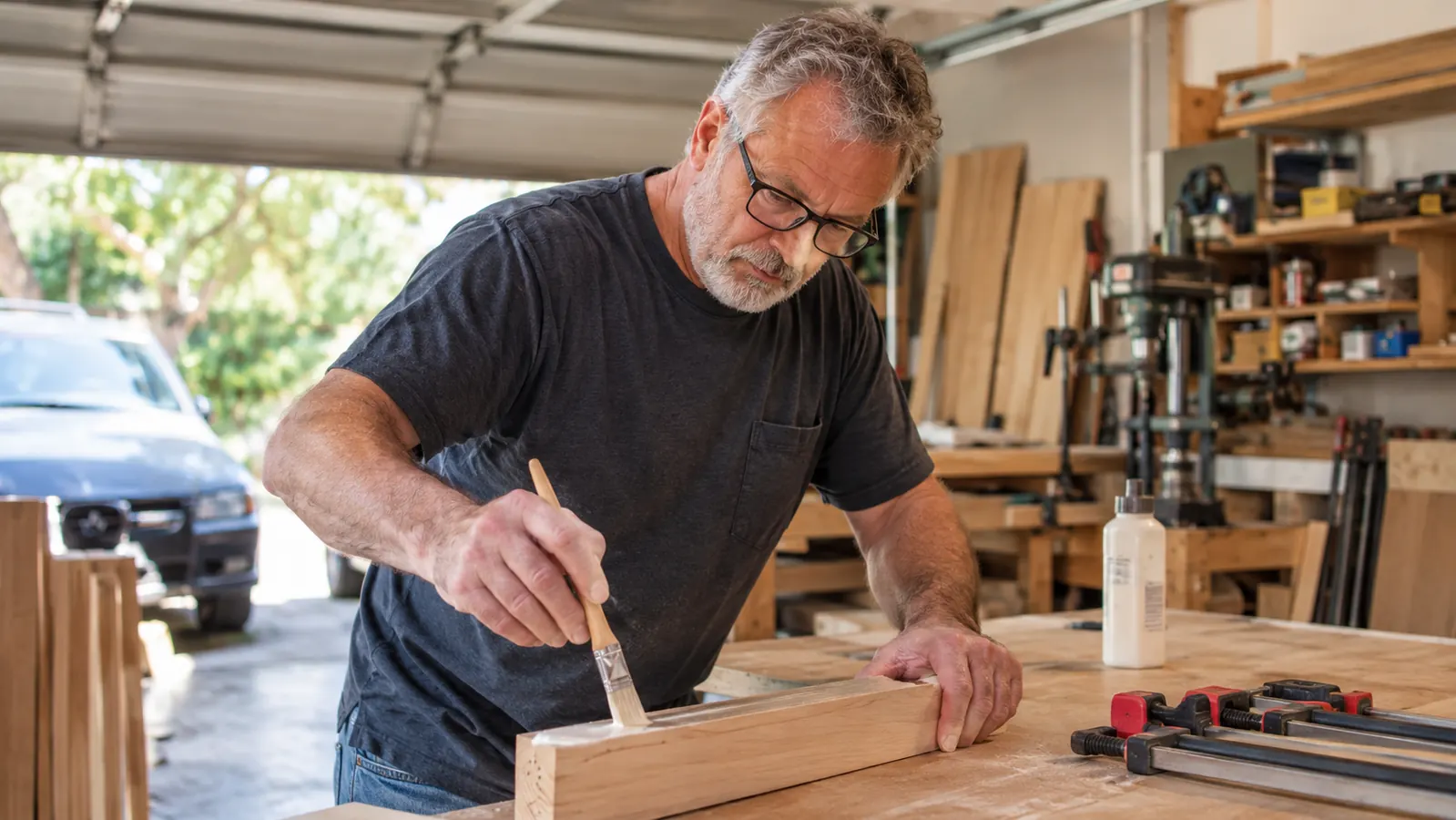
Nine out of ten questions I get about Titebond III are really the same question wearing different hats. Not how strong is it, not is it waterproof. How long do I have? How long from the moment I spread it until the joint stops moving on me? That is the number that decides whether a glue-up goes quietly or turns into a small panic in a cold garage. I have been using Titebond III for about twelve years, a 16-ounce bottle at a time, and the honest answer depends on a few things the label cannot see.
Before this I used Titebond Original, and before that whatever the lumber yard had on the shelf. Thirty-four years as a finish carpenter taught me that glue is the cheapest thing in any project and the most expensive thing to get wrong. A board costs more than a bottle. A walnut tabletop costs a great deal more. So I am not loyal to a label out of sentiment. I am loyal to it because it has not cost me a project.
The Quick Verdict
Honest version: eight to ten minutes of working time that is enough for small and medium assemblies, water cleanup while wet, and a genuine exterior rating. It is not a gap filler, and the glue line dries light enough to show on dark wood.
Amazon Check Today's Price →Twelve years of glue-ups, one bottle at a time
The 16-ounce bottle is the size that lives on my bench. Check the current price and the available sizes on the listing before you commit to one.
Amazon Check Today's Price on Amazon →How I've Used It
My shop is a two-car garage outside Boise. Concrete floor, one small electric heater, a maple workbench I built myself. It is cold in January and dry the rest of the year. Everything I glue in that shop, I glue with Titebond III. The cherry bookcase two winters ago. The walnut dining table I built for Marit last winter. The shaker end tables I am finishing now. And the cutting boards I give away every Christmas, which is the test that matters most around here, because a cutting board gets washed.
I buy the 16-ounce bottle. The listing puts it at 500 grams and 473 milliliters, which is the same quantity written two ways. When it runs out I buy another. I have never had a bottle spoil on me, and I think the reason is boring: it stays indoors instead of on a shelf in an unheated garage. Glue that has frozen is glue you should not trust.
One thing I want to be clear about before anything else. This glue will not make you a better woodworker. It will hold a joint that fits and it will not fix a joint that does not. When somebody tells me a glue failed, what usually failed was the fit. Cupped boards, an edge that was not jointed square, clamps that were not brought down evenly. No bottle in the world rescues that, and it is unfair to the glue to say otherwise.
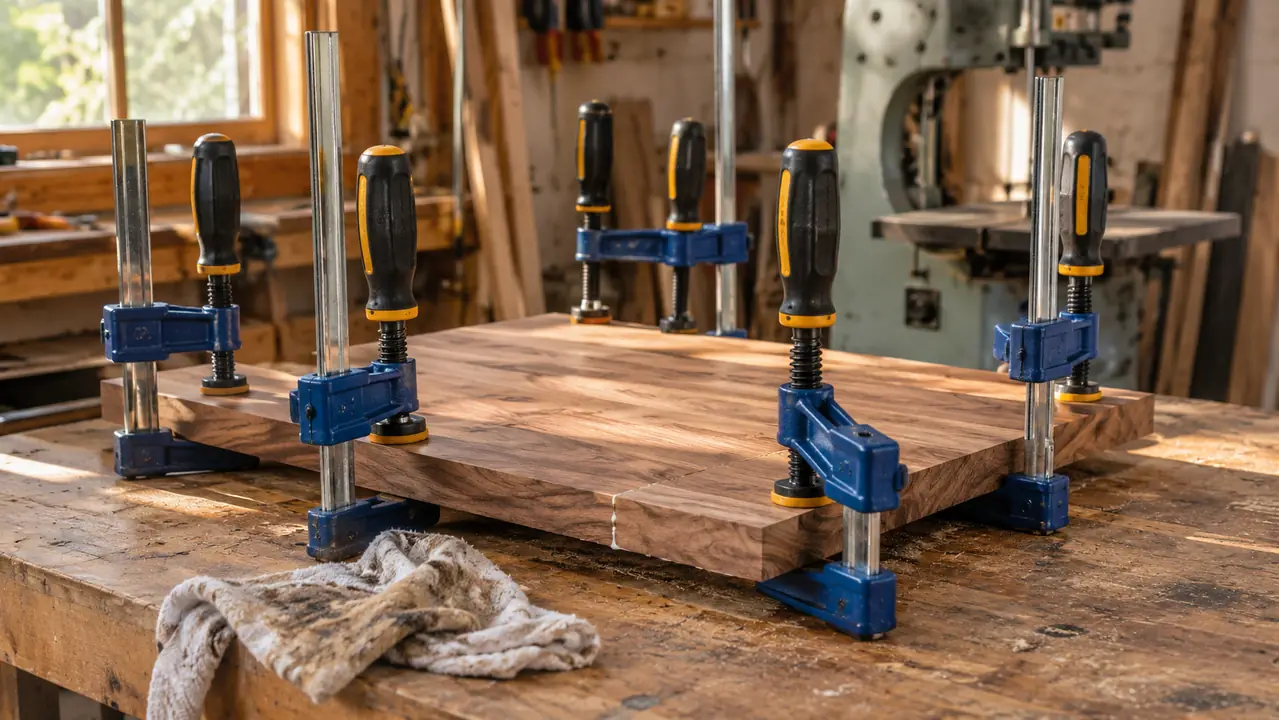
The walnut table was the biggest glue-up I have done at home. Four boards, edge jointed, glued in one pass. I laid out seven pipe clamps and two cauls, checked the dry fit twice, then worked from the middle of the panel outward so the glue was being pushed ahead of the joint instead of trapped behind it. That is the only time in recent years I have been genuinely aware of the clock. It went fine. That is not a story about the glue being remarkable. It is a story about being ready, and the glue gave me exactly the time it promised and not a minute more.
The cherry bookcase was the job that taught me about temperature. Two winters ago, a cold snap came through and the garage sat around 38 degrees overnight. I wanted to keep working. I brought the boards into the house, let them sit two days, glued the case in the shop with the heater running an hour first, then carried it back inside to cure. That is more trouble than most people want to take on, and it is the difference between a case that stays square and one that opens a joint at the back by spring.
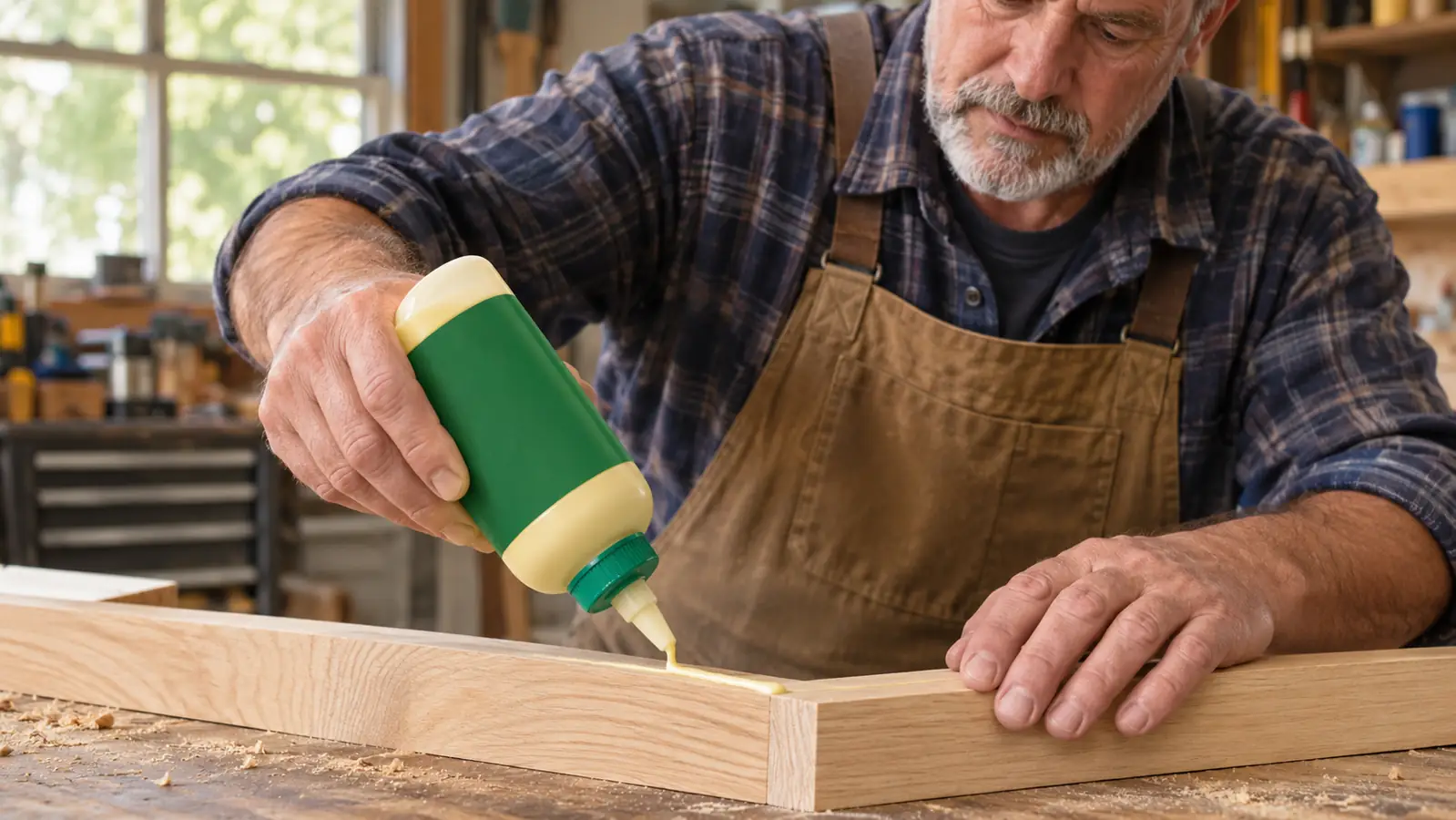
Open Time: What Eight to Ten Minutes Really Feels Like
Titebond III gives me about eight to ten minutes of working time in a shop around 65 to 70 degrees. That is my number, from my hands, in my garage, on my lumber. Spread the bead, bring the parts together, get the clamps on and snug, and you want to be finished inside that window. If you are still hunting for a third pipe clamp at minute nine, you have already lost the argument.
Eight minutes sounds generous on paper. It is generous on a picture frame and it is stingy on a tabletop. A wide panel takes clamps every foot or so plus a caul or two, and every one of those clamps has to be set, threaded and brought down evenly. The glue does not care that you are not ready. So I am ready before I open the bottle. I dry fit the whole assembly. I lay out every pipe clamp where my hand will find it without looking. I check that the cauls sit flat. The actual glue-up is the last two minutes of a job I rehearsed for twenty.
Here is a concrete example. A set of shaker end tables, four legs and two aprons each, eight joints per table. I glue one table at a time, never two, because two tables is sixteen joints and sixteen joints is not an eight-minute job no matter how fast your hands are. I spread glue in the first table's mortises, set the aprons, add the legs, and bring four pipe clamps down in sequence. By the time the fourth one is snug I can feel the glue starting to grab. The window closes from the far end of the assembly first.
Summer shortens the window. A garage in August gets warm, warm glue moves faster, and I have learned to break the work into smaller sub-assemblies in July than I would in October. Winter is the opposite problem and a worse one. Titebond III does not want to be used below 47 degrees. I take that line seriously. In January the bottle comes into the house the night before, I run the heater until the shop is honestly warm rather than merely less cold, and I put a hand on the wood instead of trusting the thermometer on the wall. Cold lumber pulls the heat straight back out of a thin film of glue, and the working time you get is not the working time on the label.
Clamping is at least an hour. I leave most things longer, because an hour is a floor and not a target, and going in for lunch is a better use of that hour than poking at a joint early. I do not put stress on a joint for 24 hours. That rule has never once let me down. A board glued at nine in the morning does not get sanded the same afternoon, no matter how much I want to see it finished.
Cleanup: Where This Glue Quietly Earns Its Place
Water cleanup while the glue is wet is the reason I stopped looking at anything else. A damp rag takes squeeze-out off the wood and off my hands. That sounds like a small convenience until you have spent an evening scraping cured glue off a panel with a card scraper and a poor attitude.
Timing is the whole thing. Wipe too early and you push glue into the pores, which becomes a finishing problem three weeks later. Wipe too late and you are scraping anyway. I give squeeze-out twenty minutes or so to skin over, then take it off with a damp rag and let the surface dry before I touch it again. On open grain like oak or ash, a rag can drive glue down into the grain, so on those I use a scraper and save the rag for cherry and maple. I also wear nitrile gloves now, which I did not use to. Not because the glue is dangerous. Because I got tired of peeling dried glue off my fingers at the end of the day.
Cured glue is a different animal, and this is the part most reviews skip. It dries to a light tan and it does not take stain. On walnut that line shows. On cherry it shows worse as the years pass, because cherry darkens with age and the glue line does not darken with it. So I do not count on cleanup to rescue a sloppy glue-up. I count on not being sloppy. Use less glue than feels right. A thin even film holds better than a fat bead, and it leaves a lot less to deal with afterward.
One evening I left squeeze-out on a cherry panel until the next morning. It had skinned and gone hard, and I spent forty minutes with a card scraper taking it back, then another twenty sanding out the marks the scraper left. The panel was fine. My evening was not. Now the damp rag comes out before the clamps do, and the whole job is two minutes instead of an hour. I have not repeated that mistake.
The Limits Nobody Prints on the Front of the Bottle
The listing says waterproof, and the standard behind that is ANSI Type I, which is a real exterior rating and not a marketing word. It is also approved for indirect food contact. Those are the two claims I actually care about and both of them hold up in my experience, which is why nothing else goes on a cutting board in this shop.
What the label does not tell you is that waterproof is not the same as gap filling. Titebond III is medium viscosity. It is not thin and it is not a paste. It wants two surfaces that meet. If a joint has a visible gap, this glue will not bridge it and hold, and you want epoxy instead. People get that backwards all the time. They see a strong glue and assume it forgives a bad fit. It does not forgive anything.
Tensile strength is listed at 4000 psi. That number is real and it is nearly irrelevant in a furniture shop, because the wood fails before the glue does. Every joint failure I have had came apart in the fibers beside the glue line, never at the glue line itself. That is not the glue failing. That is the fit failing or the joint design failing, and the glue simply showed me where.
Temperature is the limit that catches the most people and I have already said my piece on it. Shelf life is the second, and it is longer than people fear as long as the cap is on and the bottle never freezes. The third is the applicator tip, which clogs between jobs no matter what you do about it. I keep a short piece of wire on the bench for exactly that. It is not a defect. It is what a bottle of glue does.
I keep the bottle on a shelf in the house, not in the garage, and I have done that since a bottle sat out through a cold snap in my early years at home. It did not look any different afterward. It just did not hold the way it had before, and I could not prove the freeze was the reason, which is exactly why I stopped risking it. A fresh bottle is nothing next to the lumber in one tabletop.
One more practical note about the bottle itself. The 16-ounce size lasts me roughly a winter of furniture work, which is a useful way to think about it if you are deciding between sizes. Glue that sits on a shelf for years is not saving you anything. Buy the size you will actually finish.
Where It Is the Wrong Glue
I keep cyanoacrylate on the bench for small repairs and for tacking a splinter down before I glue it properly. I keep epoxy for gap filling and for anything that is not wood. Titebond III is compatible with wood. That is what it does, and it does not pretend otherwise.
It is also not the glue for a joint that may need to come apart in thirty years. Hide glue has that property and this does not. If you are building something you expect somebody to repair a generation from now, that is a different conversation and a different bottle.
And exterior rated is not the same word as engineered. A garden bench with a loose tenon and a lot of glue sitting in the gap is still a garden bench with a loose tenon. The glue will hold whatever the joint gives it to hold.
What I Liked
- Eight to ten minutes of working time in a normal shop, enough to get clamps on a small or medium assembly without rushing
- Cleans up with water while wet, so squeeze-out does not become an evening of scraping
- ANSI Type I waterproof rating and approval for indirect food contact, which is why it is the cutting board glue here
- Dries to a light tan that sands normally once cured
- A 16-ounce bottle carries me through about a winter of furniture work
Where It Falls Short
- The light glue line shows on dark woods like walnut, so fit and cleanup matter more than they would otherwise
- Not a gap filler. A joint with a visible gap will still fail
- Working time drops fast in a hot shop, and the glue should not be used below 47 degrees
- The applicator tip clogs between uses
- No built-in spreader, so you need a finger, a brush or a small roller
Tensile strength is listed at 4000 psi. I have never had a joint fail at the glue line. Every failure I have had came apart in the wood beside it. That tells you the glue did its job and the joint design did not.
Who This Is For
The home furniture builder with a small shop and a few pipe clamps. The person making cutting boards as gifts who needs a glue that survives a sink and is approved for indirect food contact. The woodworker doing interior work who occasionally builds something that lives outside and does not want two bottles on the shelf for that reason. If you fit your joints properly, lay out your clamps before you open the bottle, and can keep the shop above 47 degrees, this glue will not be the thing that fails on you.
Who Should Skip It
If your joints have visible gaps, buy epoxy. If your shop is an unheated garage and you are not willing to warm it or bring the wood inside, wait for spring. If you want one adhesive for wood, metal, plastic and ceramic, this is not that, and no wood glue is. And if you are gluing up large panels in a warm shop on a tight schedule, a glue with a longer open time will save you more grief than this one will, honest as it is.
Buy the size you will actually finish
A 16-ounce bottle is a winter of furniture work for me. If you glue less often, a smaller bottle and a fresh one next year beats a big one going off on the shelf.
Amazon See Current Price and Sizes on Amazon →